
Cloud security, zero trust, and managed SOC services are now essential for Indian businesses facing rising cyber threats. See how to build a resilient defense.
"Never trust, always verify." That five-word principle, coined by security analyst John Kindervag more than a decade ago, has quietly become the operating philosophy for every enterprise that has watched its perimeter dissolve into a scatter of cloud workloads, remote employees, and third-party APIs. In India, where digital adoption is accelerating faster than almost anywhere else in the world, that quote has stopped being a talking point at security conferences and become a boardroom mandate.
The State of Cyber Risk in India's Digital Economy
India's digital economy is expanding at a pace that few regulators, security teams, or budgets have been able to match. The National Payments Corporation of India's own transaction data shows that the Unified Payments Interface now processes more than 15 billion transactions every month, and that scale alone has turned real-time identity fraud into a daily operational problem for banks and fintechs.
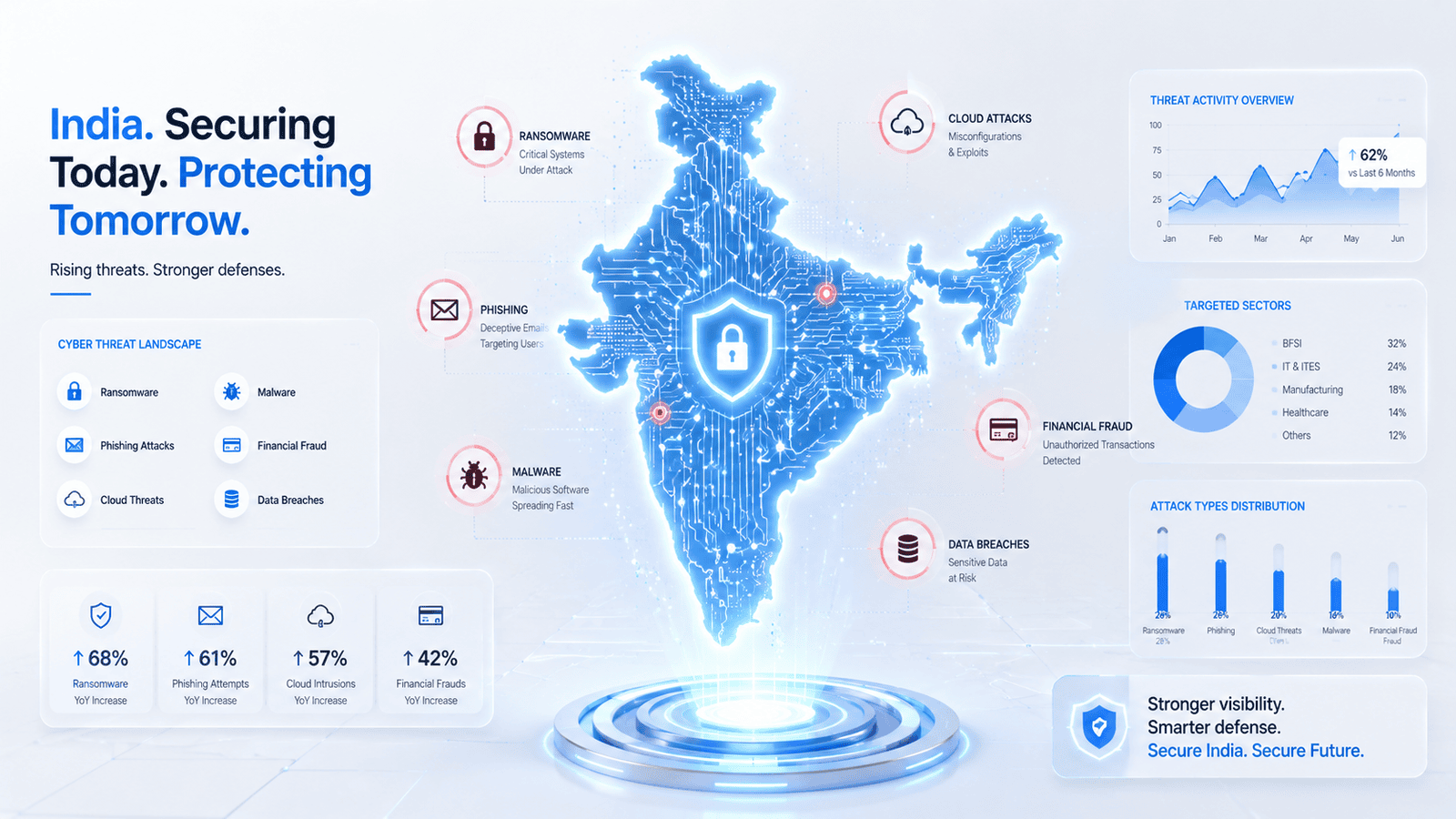
The threat numbers reflect this pressure. Industry trackers estimate that cyberattack-related losses in India crossed ₹20,000 crore in 2025, a figure that does not even account for penalties under the Digital Personal Data Protection Act or breaches that were never publicly reported. According to a Q1 2026 threat report covered by BusinessWorld, India was the most targeted country for ransomware in the Asia-Pacific region during the first quarter of the year, with manufacturing, IT, healthcare, and BFSI sectors bearing the brunt of the attacks. Cloud misconfigurations and identity and access management gaps are now implicated in the majority of cloud-related detections, a pattern that shows up consistently across recent industry telemetry.
Simultaneously, India's cybersecurity spending is growing to match the risk. Mordor Intelligence's market analysis puts the India cybersecurity market at roughly USD 6.56 billion in 2026, on track to exceed USD 15 billion by 2031, driven in large part by cloud-first government programmes, rising breach volumes, and tougher data-protection rules. Separately, IMARC Group's research projects that Indian enterprises will spend over USD 24 billion on cloud infrastructure by 2026 alone, spending that has to be matched, rupee for rupee, with investment in cloud workload protection, identity security, and continuous monitoring, or it simply expands the attack surface without expanding the defence.
What Zero Trust Security Really Means for Indian Enterprises
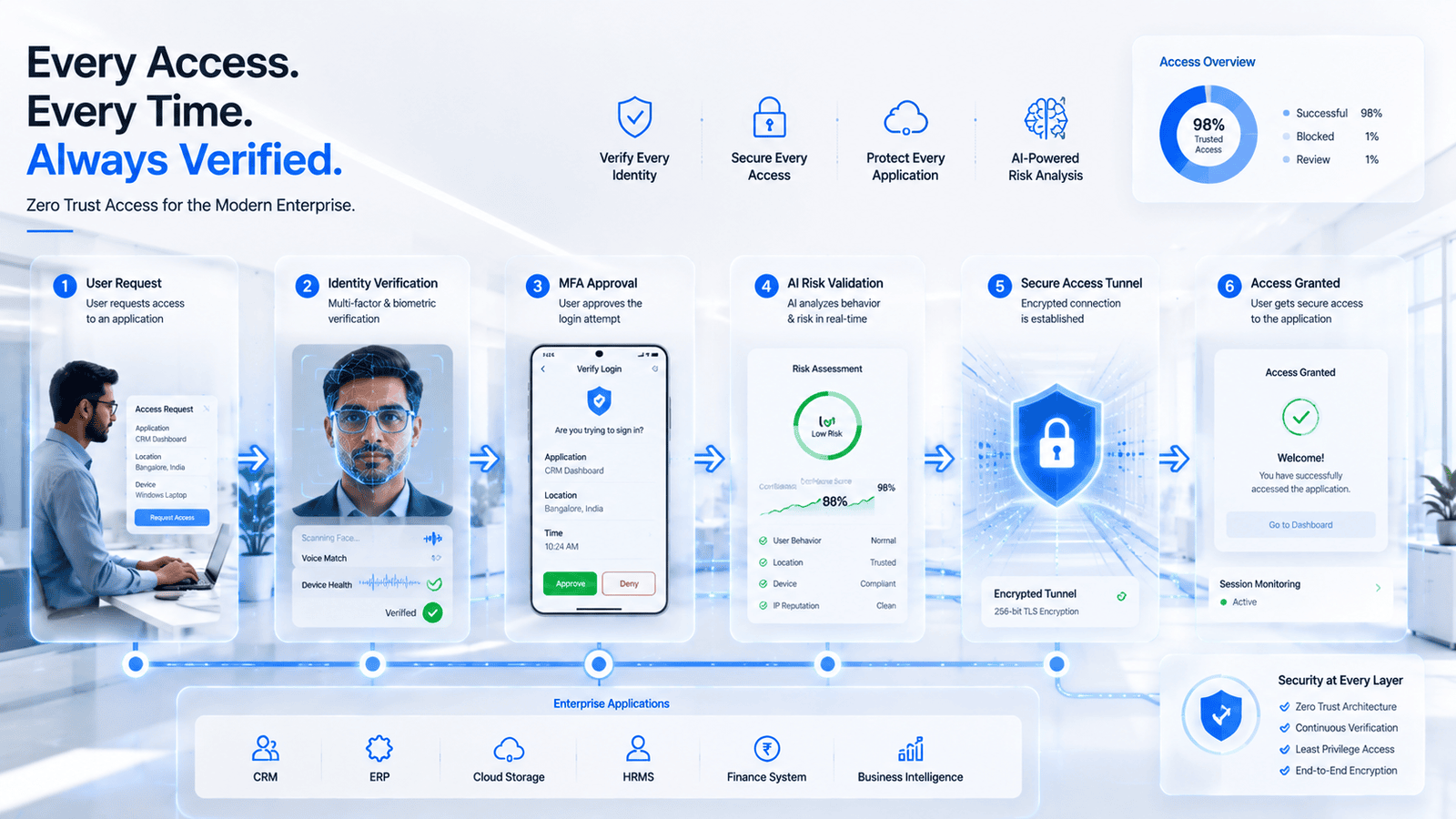
Zero trust security is often reduced to a marketing term, but the underlying idea is straightforward: no user, device, or application should be trusted by default, regardless of whether it sits inside or outside our network perimeter. Every request for access has to be authenticated, authorised, and continuously validated based on context, who is asking, from what device, at what time, and with what level of risk attached to that session.
This matters enormously in India’s current environment because the traditional idea of a "trusted internal network" has effectively disappeared. Our employees work from home, from co-working spaces, and from client sites. Our applications live across AWS, Azure, and Google Cloud simultaneously. Our vendors and outsourcing partners have their own logins into our systems. Every one of those connection points is a potential entry for an attacker, and the Digital Personal Data Protection Act now holds us directly accountable for how well we control that access.
Market analysts have taken notice of how quickly this shift is happening. Research and Markets' latest zero trust security report values the global zero trust security market at over USD 54 billion in 2026, growing at more than 21% annually as organisations move away from perimeter-based models. India is consistently flagged in these reports as one of the fastest-growing markets for zero trust adoption in the Asia-Pacific region, driven by cloud migration, remote work, and compliance pressure from the DPDPA.
For us, adopting zero trust security is not about buying a single product. It's a shift in philosophy: assume compromise is possible at any point, and design every system so that a single stolen password or infected laptop cannot become a company-wide breach.
The Core Pillars of a Zero Trust Architecture
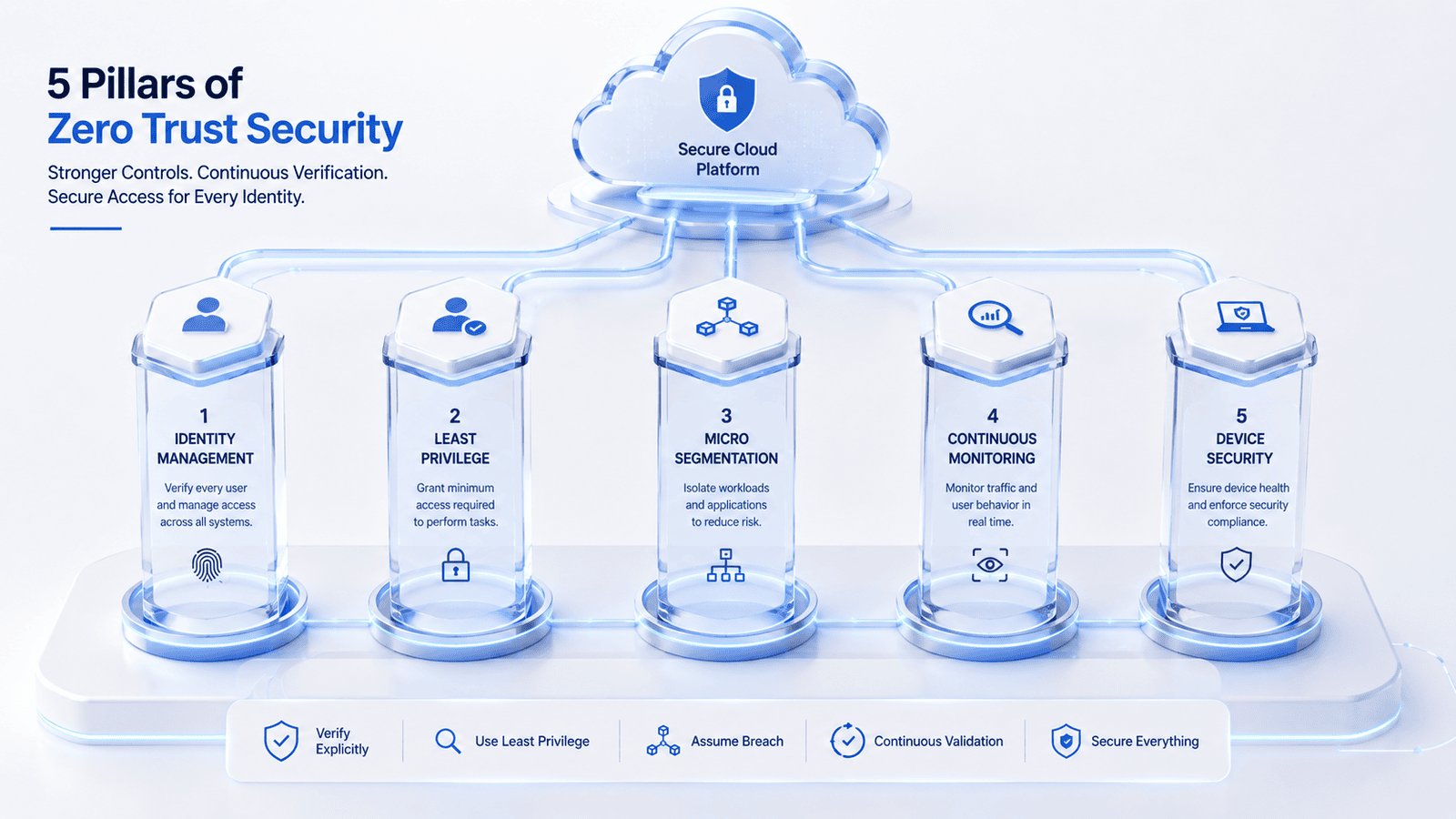
A genuine zero trust architecture rests on a handful of interconnected capabilities, and skipping any one of them leaves a gap that attackers are quick to find.
Identity and access management sits at the centre of it all. Every user and every service account needs a strong, verifiable identity, backed by multi-factor authentication and adaptive risk scoring rather than a static password.
Micro-segmentation breaks our network and cloud environments into small, isolated zones, so that even if an attacker compromises one system, they cannot move laterally to reach our most sensitive data.
Least-privilege access ensures that people and applications only get the permissions they need for the task in front of them, and nothing more, a principle that sounds obvious but is routinely violated in fast-growing organisations where access requests pile up faster than they get reviewed.
Continuous monitoring and analytics replace the old "log in once, trust forever" model with ongoing behavioural analysis, flagging anomalies like an account suddenly downloading large volumes of data at 2 a.m. or logging in from two countries within an hour.
Device posture checks verify that the laptop or phone requesting access is patched, encrypted, and free of known malware before it's allowed anywhere near production systems.
What Comprehensive Cloud Security Services Should Cover
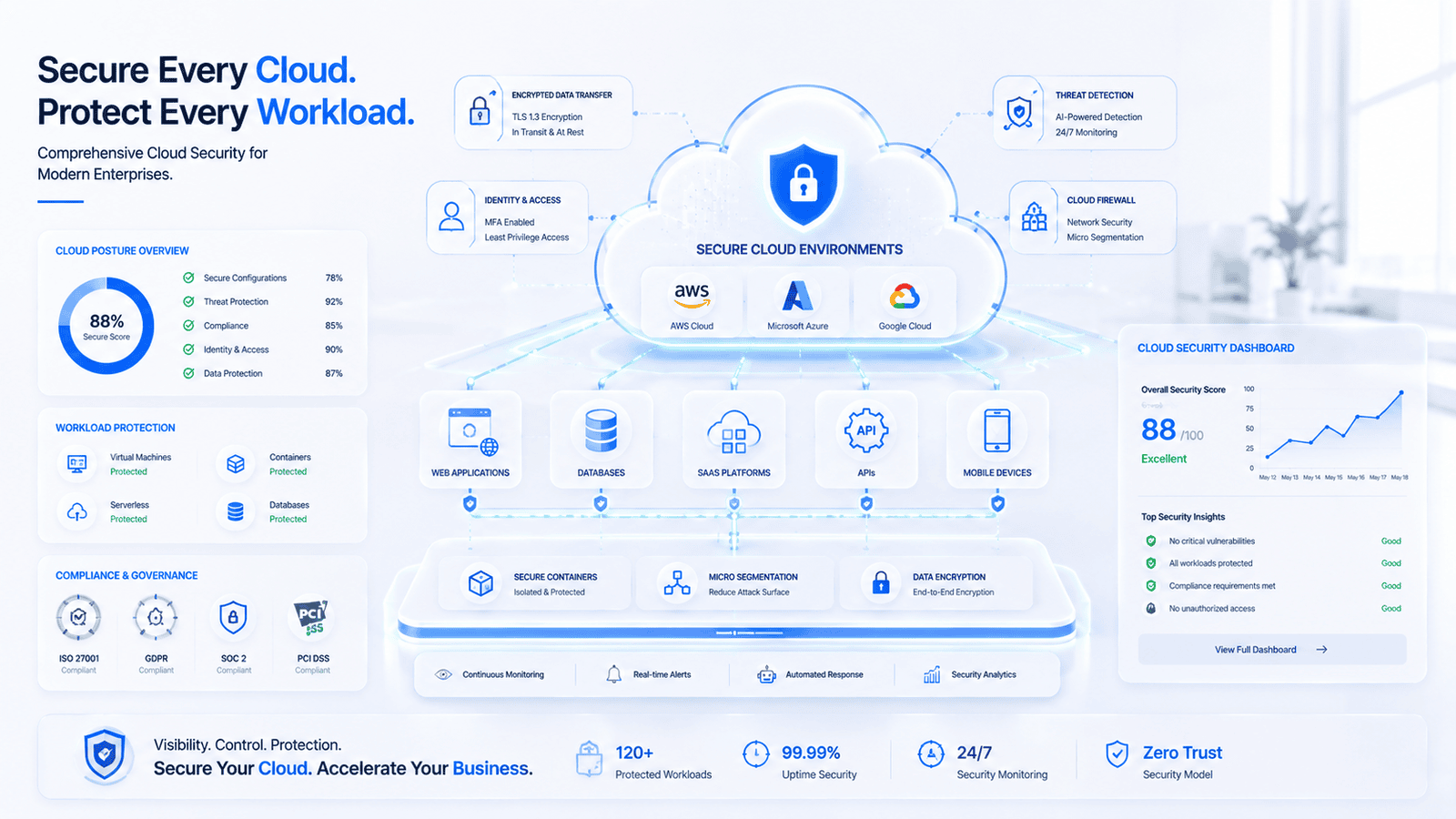
"Cloud security" has become a catch-all phrase, so it's worth being specific about what a comprehensive set of cloud security services should actually include for an Indian enterprise operating across hybrid or multi-cloud environments.
At a minimum, this means cloud security posture management (CSPM) to continuously scan for misconfigurations, the single largest source of cloud breaches, and one that Indian security researchers have repeatedly flagged as involved in the majority of cloud-related detections. It means cloud workload protection for the virtual machines, containers, and serverless functions that now run the bulk of our production applications. It means data loss prevention controls that follow sensitive data wherever it travels, not just where it sits at rest. And it means web and email security layered on top, since phishing remains the single most common way attackers get their first foothold, even in organisations with mature cloud defences.
Delphi Infotech's own advanced threat protection framework illustrates how these pieces fit together in practice, combining intrusion detection, round-the-clock monitoring, and proactive threat hunting into a single layered defence, rather than treating each capability as a separate purchase. That layered approach matters because attackers do not respect the boundaries between our procurement categories. A single campaign might start with a phishing email, move laterally through a misconfigured storage bucket, and end with data exfiltration through a compromised API key, and a fragmented security stack, where each tool only sees one piece of that chain, will miss the pattern every time.
Cloud security services should also be sized to the reality of Indian mid-market and enterprise IT teams, most of which are running lean. That's precisely why so many organisations are choosing to combine their cloud security investment with a managed service model rather than trying to staff a 24x7 security function in-house.
Why Managed SOC Services Are Becoming Essential
A Security Operations Center is the team and technology stack responsible for monitoring, investigating, and responding to security incidents around the clock. Building one in-house requires certified analysts working in shifts, expensive SIEM licensing, and a constant pipeline of threat intelligence, resources that are simply out of reach for the majority of Indian mid-sized businesses, and a stretch even for many large enterprises.
This is the gap that managed SOC services are built to close. Rather than hiring and retaining an internal team that has to be available every hour of every day, we can access a fully staffed, 24x7 security operations function on a subscription basis, backed by analysts who are watching threat patterns across dozens of client environments rather than just one. Delphi Infotech's own SOC services page frames this well: a modern SOC exists to make sure the underlying monitoring platform actually delivers actionable insights and continuous defence, rather than sitting unused because no one has the time to review its alerts.
Industry research backs up why this model is gaining traction so quickly in India. Analysts at MarketsandMarkets have pointed to an ongoing shortage of trained cybersecurity professionals and SOC analysts as one of the biggest structural challenges facing Indian businesses today, pushing continued reliance on managed security services providers for monitoring and incident response. In practice, this means the choice for most organisations isn’t "build our own SOC or go without", it’s "partner with a managed SOC provider or accept a dangerous gap in coverage."
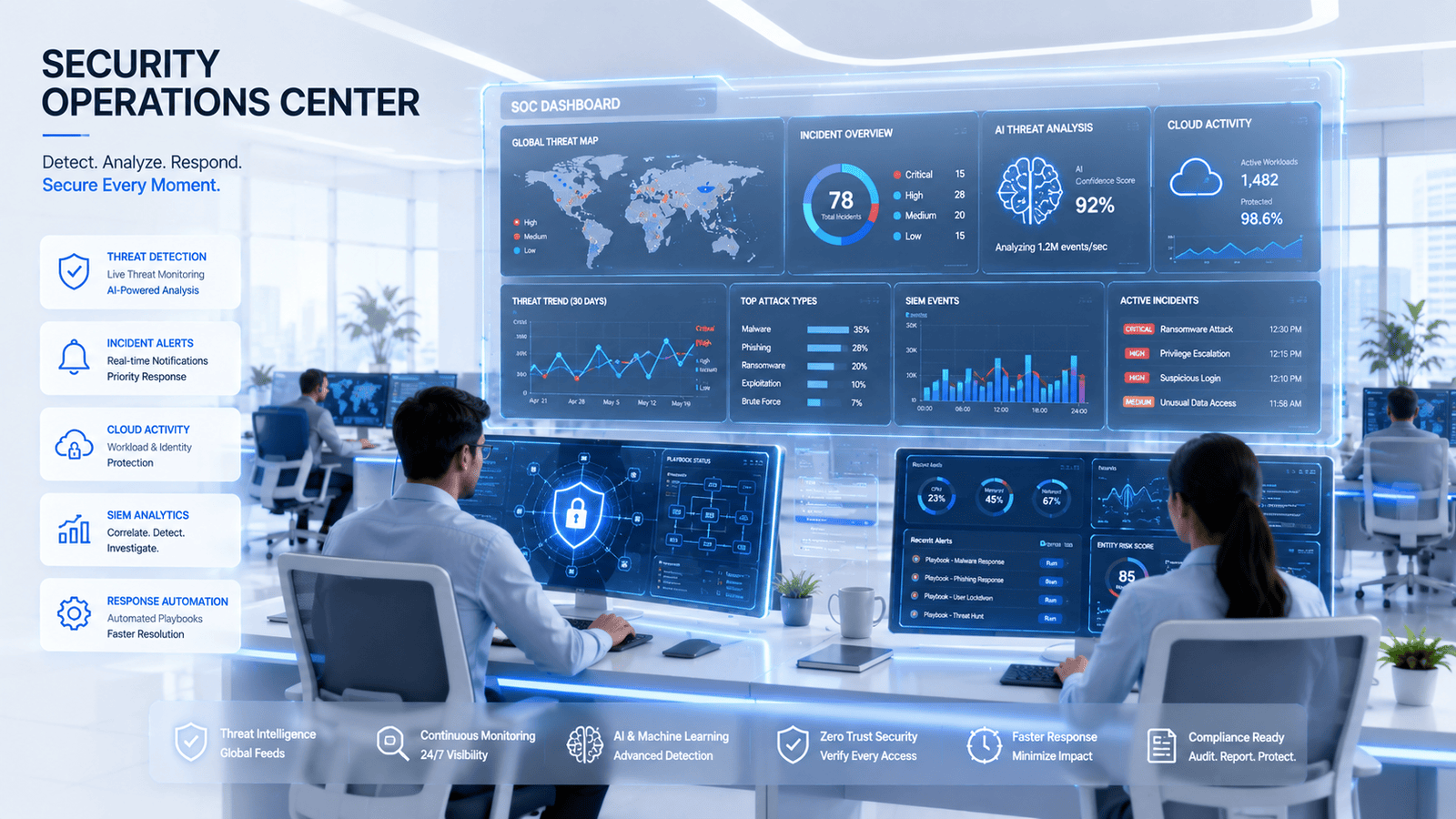
Inside a Modern SOC: SIEM, SOAR, and Threat Hunting
To understand what we're actually paying for with managed SOC services, it helps to look at the technology stack running underneath it.
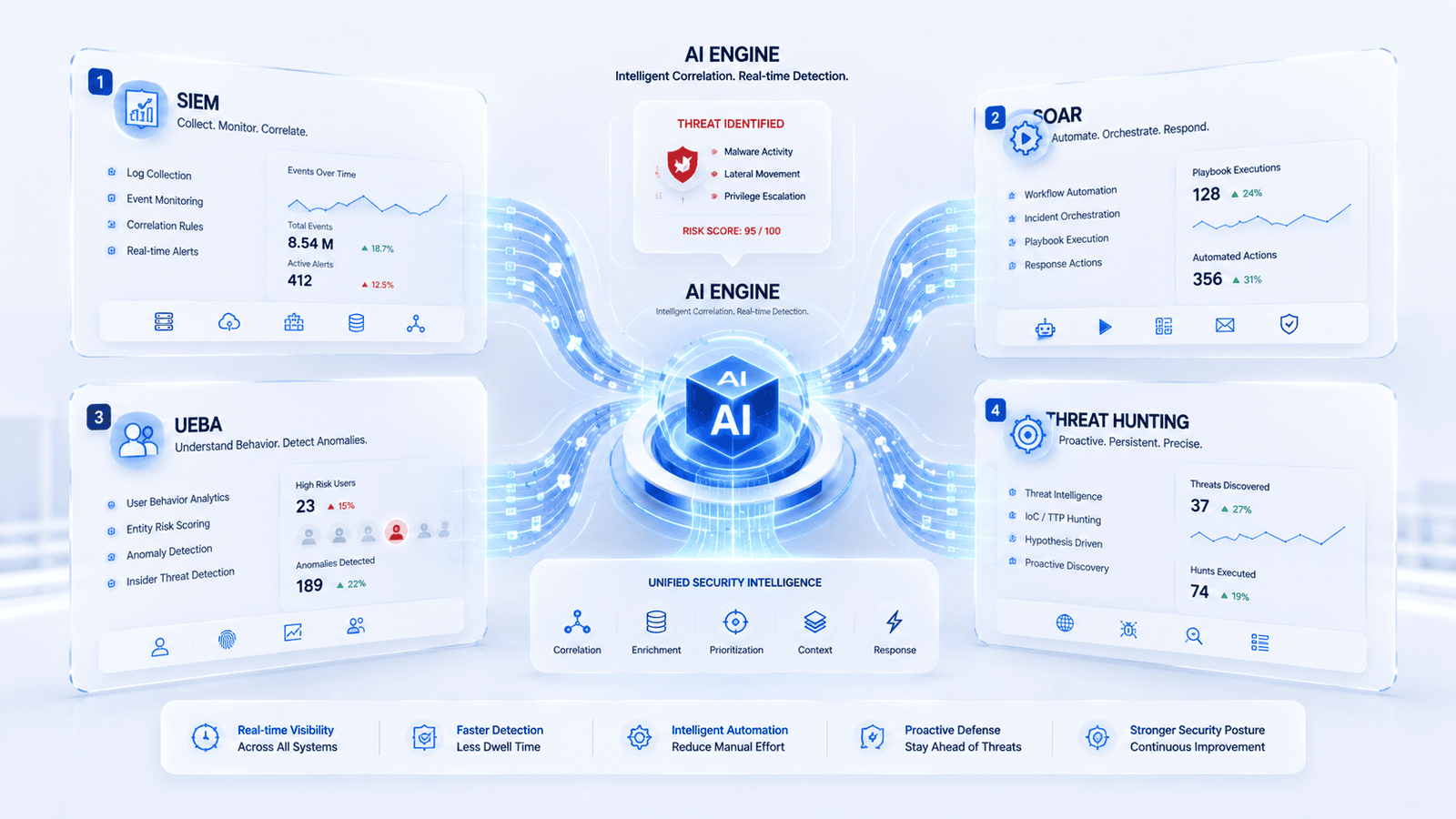
Security Information and Event Management (SIEM) platforms sit at the core, collecting and correlating security data from firewalls, endpoints, cloud platforms, and applications across our environment. On their own, SIEM tools generate an overwhelming volume of alerts, which is exactly why they need skilled analysts, and increasingly AI-assisted triage, to separate genuine threats from background noise.
Security Orchestration, Automation, and Response (SOAR) tools take that a step further, automating repetitive response actions like isolating a compromised endpoint or blocking a malicious IP address, so that human analysts can focus on the incidents that actually require judgement rather than repetitive manual work.
User and Entity Behaviour Analytics (UEBA) adds a behavioural layer, learning what "normal" looks like for every user and system, and flagging deviations, an employee account suddenly accessing systems it has never touched before, or a service account moving unusually large volumes of data.
Proactive threat hunting rounds out the stack. Rather than waiting for an alert to fire, threat hunters actively search our environment for signs of adversaries who may already be inside but have not yet triggered an automated detection, a discipline that has become increasingly important as attackers get better at operating quietly and living off the land.
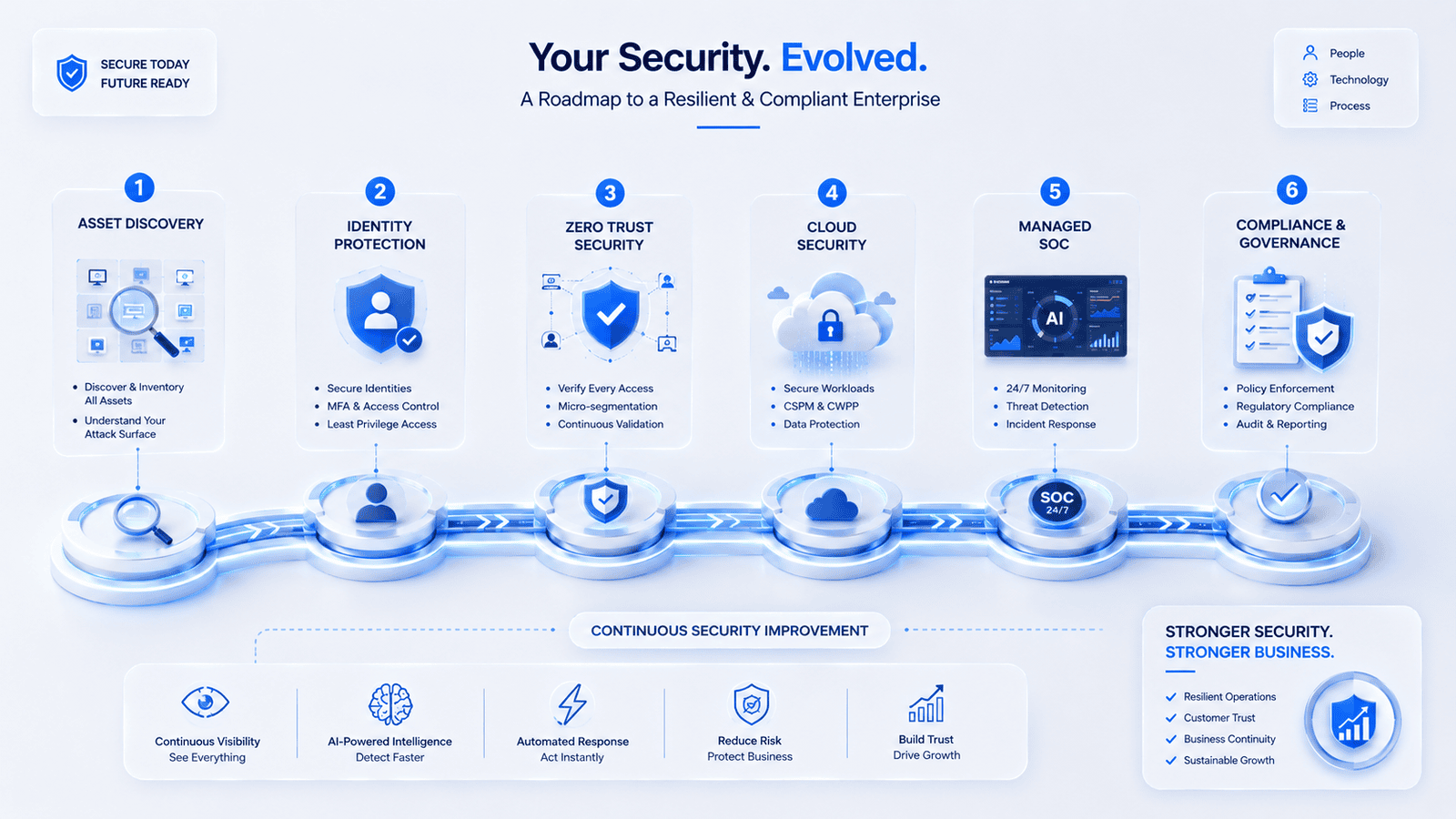
Building an Integrated Zero Trust and Cloud Security Roadmap
The organisations getting the most value out of their security investment are not treating zero trust security, cloud security services, and managed SOC services as three separate purchases. They're building them as one integrated roadmap.
A practical starting point is an honest asset and identity inventory: what applications, cloud accounts, and data stores actually exist, and who has access to each of them. From there, the roadmap typically moves through strengthening identity and access management with multi-factor authentication and adaptive controls, layering in cloud security posture management to close configuration gaps, segmenting critical systems so a single compromised account cannot reach everything, and finally connecting all of that telemetry into a managed SOC that can watch it continuously and respond in real time.
The sequencing matters. Deploying zero trust controls without a SOC watching the resulting signals leaves valuable detection data going nowhere. Conversely, running a SOC without strong identity and cloud posture controls means analysts spend their time chasing alerts that better architecture could have prevented in the first place. The two disciplines are meant to reinforce each other, not compete for budget.
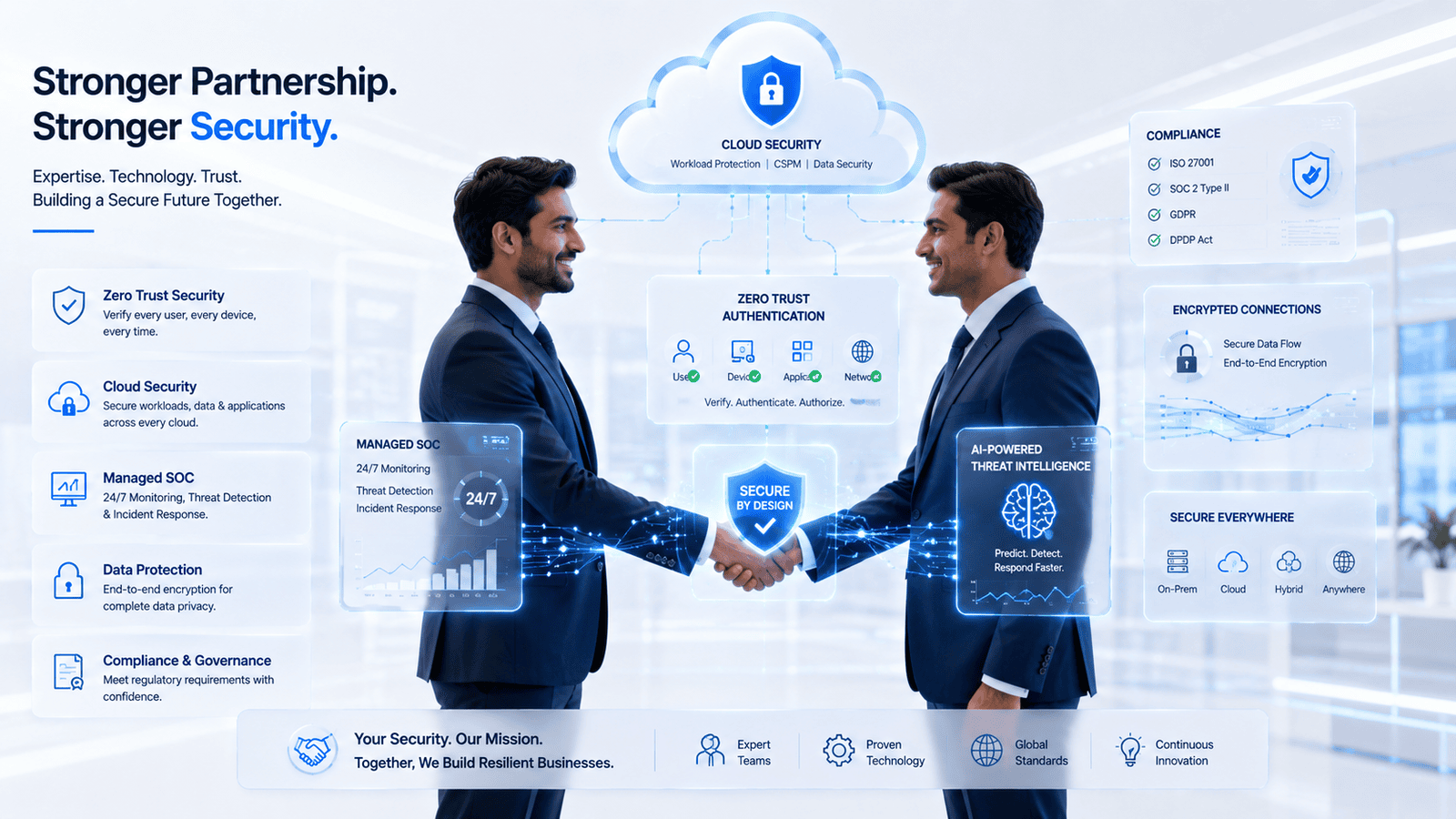
Choosing the Right Cybersecurity Partner in India
With so many vendors promising cloud security, zero trust, and managed SOC capabilities, the real differentiation comes down to a few practical questions.
Does the provider offer genuine 24x7 coverage, with analysts actively monitoring around the clock, or is "24x7" really an on-call rotation that gets to alerts hours later? Can they demonstrate experience with the specific compliance frameworks that matter for our sector, DPDPA for most businesses, RBI guidelines for BFSI, or sector-specific requirements for healthcare and critical infrastructure? Do they integrate cloud security posture management, identity controls, and SOC monitoring into one coherent platform, or will we end up stitching together alerts from disconnected tools ourselves?
We should also weigh how a provider's partner ecosystem shapes the actual technology we're relying on. A cybersecurity company that works with established platforms across email security, endpoint protection, and SOC tooling, rather than a single proprietary stack, tends to offer more flexibility as our needs evolve and as the threat landscape shifts.Delphi Infotech, for instance, positions its state-of-the-art Security Operations Center alongside a broad partner network spanning email security, data loss prevention, and vulnerability management, reflecting the layered approach that comprehensive protection now demands.
Key Takeaways
- India's cyberattack losses passed ₹20,000 crore in 2025, and the country was the most targeted in the Asia-Pacific region for ransomware in early 2026, the risk is immediate, not theoretical.
- Zero trust security replaces implicit trust with continuous verification of every user, device, and application, and is one of the fastest-growing security investment categories in India.
- Comprehensive cloud security services need to cover posture management, workload protection, data loss prevention, and web and email security together, not as isolated purchases.
- Managed SOC services close the resourcing gap that most Indian businesses face when trying to staff round-the-clock security monitoring on their own.
- SIEM, SOAR, UEBA, and proactive threat hunting are the technology stack that separates a genuine managed SOC from basic log monitoring.
- The greatest value comes from integrating zero trust, cloud security, and managed SOC services into a single roadmap rather than treating them as separate line items.
- DPDPA compliance increasingly depends on being able to demonstrate exactly this kind of layered, continuously monitored security posture.
Frequently Asked Questions
Q: What is the difference between cloud security and zero trust security?
A: Cloud security refers to the tools and practices that protect our cloud infrastructure, applications, and data, things like posture management and workload protection. Zero trust security is a broader philosophy about how access is granted and verified across our entire environment, cloud included. In practice, the two work together: zero trust principles are applied through the identity, segmentation, and monitoring controls that make up a strong cloud security programme.
Q: Do small and mid-sized businesses in India actually need managed SOC services?
A: Yes, arguably more than large enterprises. Smaller organisations rarely have the budget to build and staff an internal 24x7 security team, which is exactly the gap managed SOC services are designed to fill. Given how much of the recent rise in ransomware and phishing activity has targeted mid-market IT, healthcare, and manufacturing firms, a managed SOC is often more accessible, and more effective, than trying to build equivalent coverage in-house.
Q: How long does it take to implement a zero trust architecture?
A: Most organisations should expect a phased rollout over several months to a year, starting with identity and access management, followed by micro-segmentation and continuous monitoring. Attempting to implement zero trust as a single "big bang" project usually creates more operational disruption than it prevents; a staged roadmap tied to business priorities tends to work far better.
Q: Is managed SOC coverage required for compliance with India's Digital Personal Data Protection Act?
A: The DPDPA does not name specific tools, but it does require organisations to implement "reasonable security safeguards" to prevent personal data breaches. Continuous monitoring, documented incident response, and demonstrable access controls, the core outputs of a managed SOC, are widely regarded as central to meeting that standard and to being able to show regulators exactly what happened if a breach does occur.
Q: What should we look for when comparing cloud security service providers in India?
A: Look for genuine round-the-clock analyst coverage rather than on-call support, demonstrated experience with relevant compliance frameworks, an integrated platform that connects cloud posture, identity, and SOC monitoring, and a partner ecosystem broad enough to adapt as the threat landscape changes.