
Learn how to prevent phishing with email authentication, MFA, asset management, compliance monitoring, and IoT security, a connected defense strategy.
Phishing is not a background noise problem. It is the front door attackers walk through. But here's what most businesses get wrong: they treat email security as a standalone project instead of one piece of a connected IT and security ecosystem. A locked front door does not help much if the windows, the back gate, and the alarm system are all managed separately, by different people, on different schedules.
What Makes Email Phishing So Dangerous?
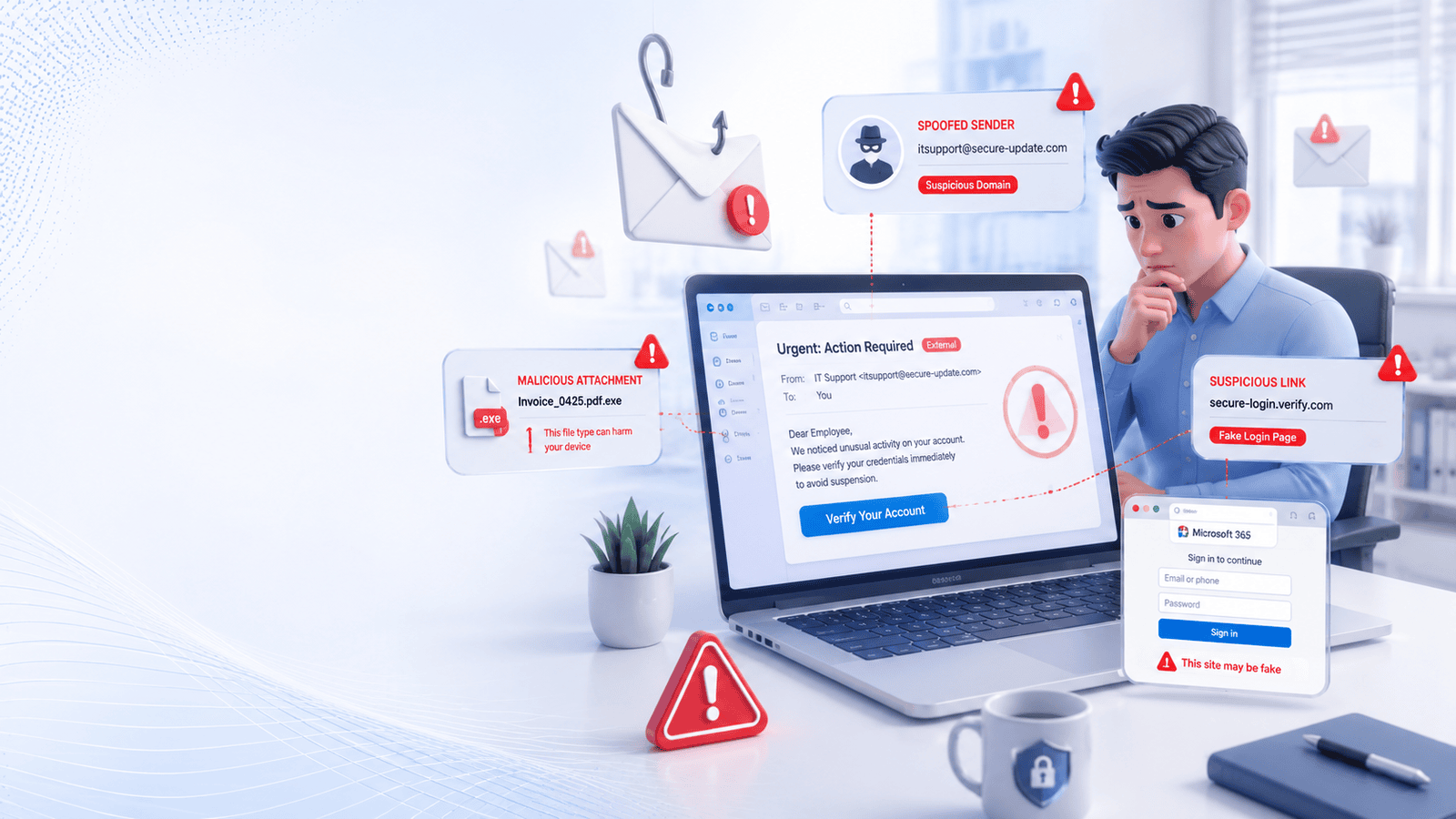
Phishing remains one of the most frequently reported categories of internet crime tracked by the FBI. Attackers craft convincing emails that impersonate trusted senders, then trick recipients into handing over credentials, clicking malicious links, or downloading malware-laden attachments.
What makes it persistently effective is not sophistication alone. It's volume, speed, and the fact that it targets people, not just systems. A majority of cyber incidents trace back to a phishing email as the initial point of entry. One convincing message sent to one distracted employee can expose an entire organization's data.
The Technical Controls That Actually Stop Phishing
A well-built email defense layers several controls on top of each other:
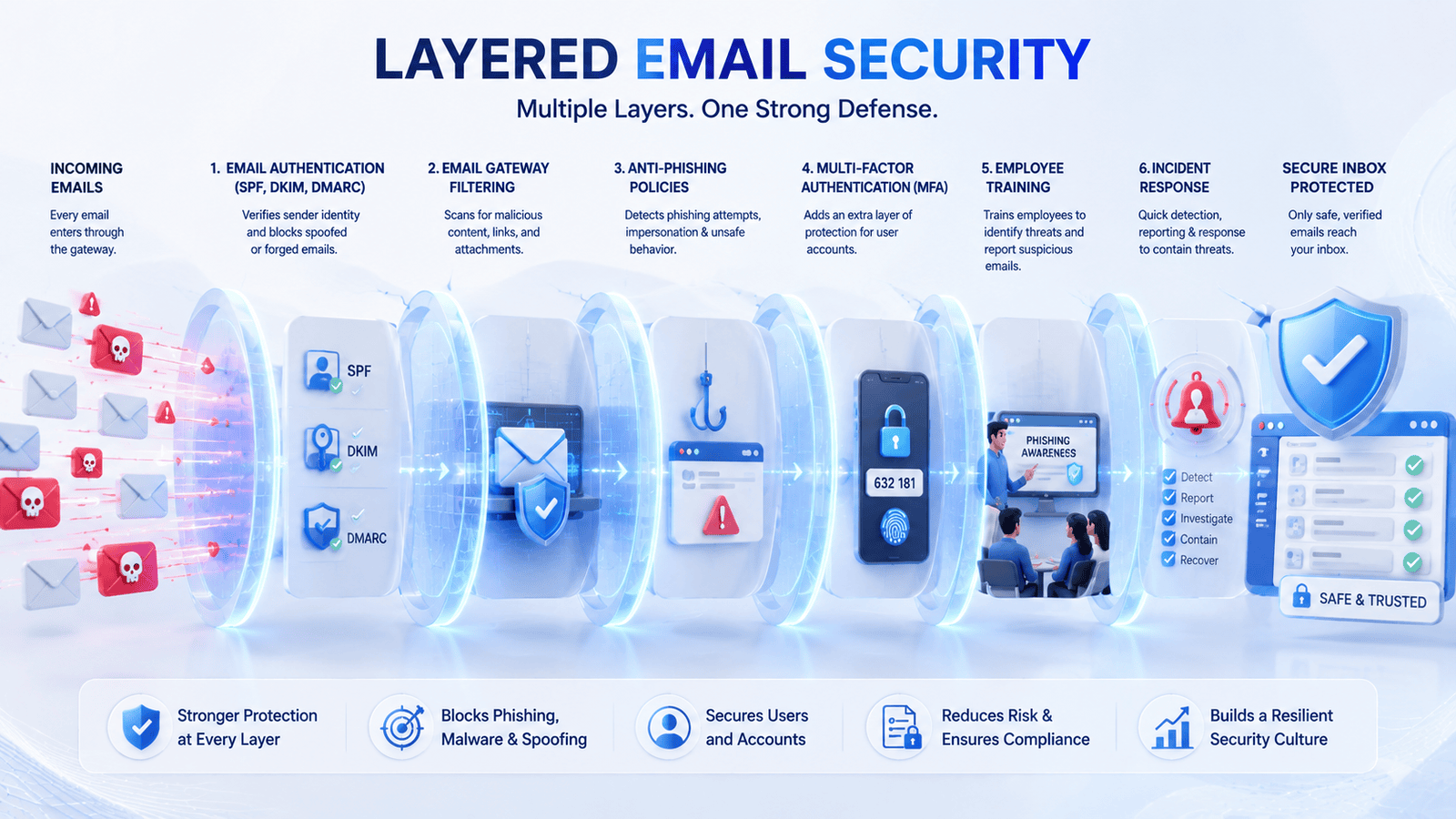
Email Authentication Protocols: SPF, DKIM, and DMARC verify that incoming messages actually originate from the domain they claim. Deploying all three blocks spoofed sender addresses before a message ever reaches an inbox.
Email Gateway Filtering: A gateway scans messages for known malicious URLs, suspicious attachments, and phishing indicators. Advanced gateways use machine learning to flag zero-day phishing attempts that signature-based filters miss.
Anti-Phishing Policies: Platforms like Microsoft 365 and Google Workspace include built-in anti-phishing policy engines. Turning on impersonation protection and safe-links scanning adds a critical inbox-level filter.
Multi-Factor Authentication (MFA): Even when credentials are stolen through phishing, MFA prevents attackers from logging in. This is arguably the single most impactful control for limiting account takeover after a successful phish.
Phishing Simulation and Employee Training: Regular simulated phishing campaigns test whether employees can spot suspicious messages and reinforce reporting habits.
Incident Response Policies: Clear internal procedures for reporting a suspected phishing email mean faster containment and less damage when something slips through.
Why Email Security Needs to Connect to Your Wider IT Environment
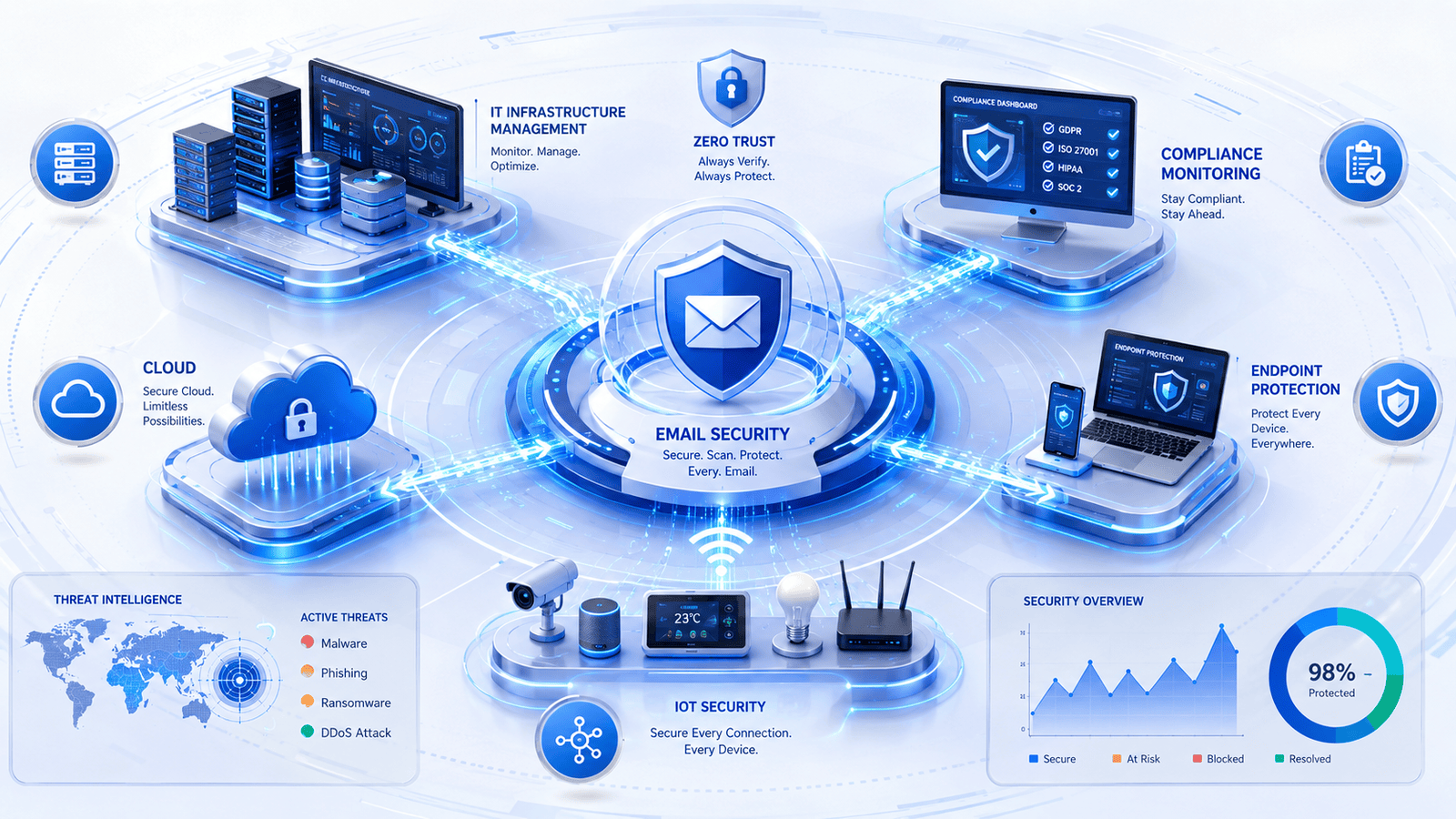
Most organizations run email protection in isolation from everything else; device management, asset tracking, compliance reporting, and connected devices all live in separate silos, sometimes managed by different vendors who never talk to each other. That's exactly where gaps open up. The sections below go deeper into each of these connection points because each one plays a distinct role once a phishing attempt gets past the inbox.
Email + IT Infrastructure Management: A phishing email that gets clicked doesn't stay a phishing problem for long; it becomes a network problem. Strong IT infrastructure management gives your team visibility into every server, endpoint, and connection point so that unusual behavior following a phishing click gets flagged and contained instead of quietly spreading across the network.
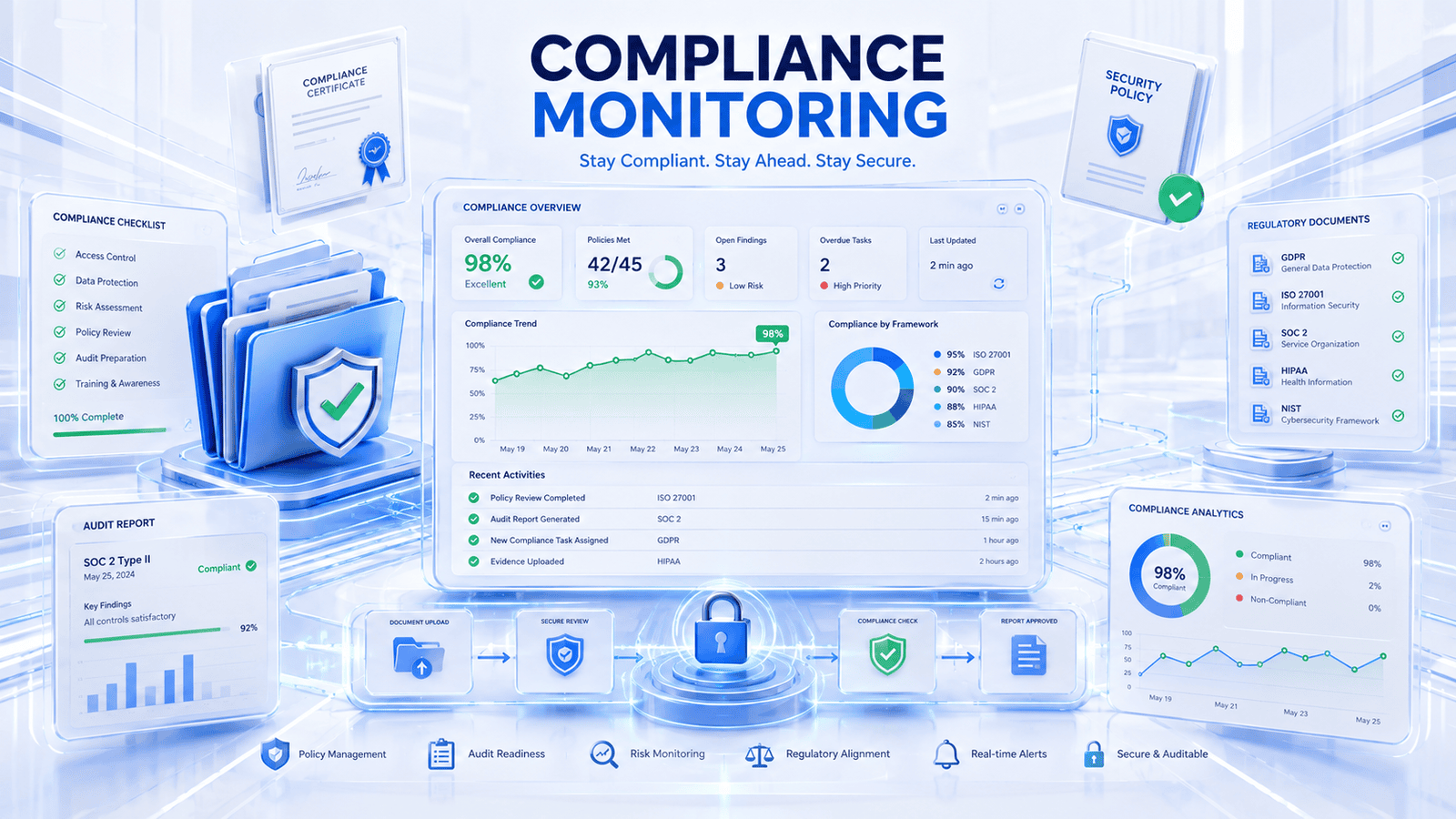
Email + Compliance Monitoring: Many phishing attacks target regulated data, including financial records, health information, and personally identifiable information. Ongoing compliance monitoring keeps your controls, documentation, and audit trails current, so if an incident does occur, you already know what data was exposed and what your reporting obligations are.
IT Infrastructure Management: The Backbone of a Resilient Security Posture
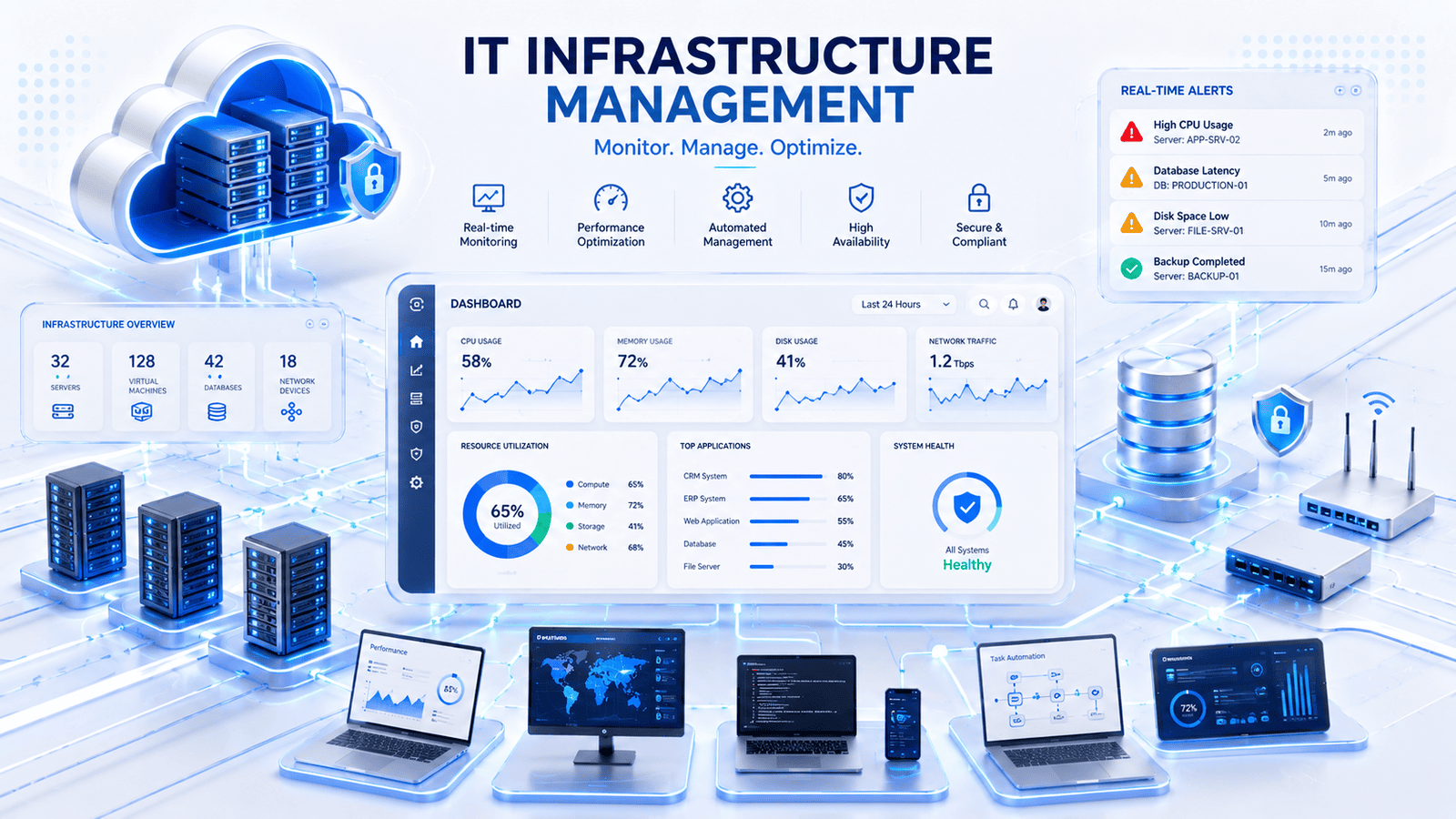
IT infrastructure management is often thought of as a back-office function, keeping servers patched, networks running, and systems available. Treated as an afterthought, though, it becomes one of the biggest blind spots in a security program. Every phishing email that gets through, every exploited vulnerability, and every unauthorized login ultimately plays out somewhere inside your infrastructure, on a server, a switch, a cloud workload, or a piece of network hardware nobody has looked at closely in months.
Strong IT infrastructure management brings a level of visibility and control that most organizations don't realize they're missing until something goes wrong. It typically covers continuous network monitoring, so unusual traffic patterns or unauthorized access attempts are flagged in real time; patch and update management, closing the vulnerabilities attackers actively scan for; performance and capacity monitoring, which doubles as an early warning system for compromised systems behaving abnormally; and backup and disaster recovery planning, so a ransomware payload delivered through a phished credential doesn't turn into permanent data loss.
The connection to phishing defense is direct. A successful phish is rarely the end of an attack; it's the beginning. Attackers use that initial foothold to move laterally across the network, escalate privileges, and search for high-value systems. Without centralized infrastructure oversight, that movement can go unnoticed for days or weeks. With it, unusual authentication attempts, unexpected data transfers, or new administrative accounts get caught early, often before real damage occurs.
For growing organizations running a mix of on-premises servers, cloud workloads, and remote endpoints, IT infrastructure management also solves a coordination problem. When infrastructure, email security, and endpoint protection are managed as separate projects, response times slow down and gaps form at the handoff points. When they're managed together as one connected discipline, incident response becomes a single coordinated process instead of three separate teams comparing notes after the fact.
Compliance Monitoring: Turning Regulatory Requirements Into an Ongoing Practice
For many industries, phishing is not just a security risk; it is a compliance risk with a clock attached. Healthcare organizations under HIPAA, financial services firms under PCI-DSS or SOX-related controls, and any business handling EU resident data under GDPR are all required to report certain types of data exposure within defined timeframes. If a phishing attack compromises regulated data and your organization can't quickly determine what was accessed, you're not just dealing with a breach, you're dealing with a compliance failure layered on top of it.
This is where compliance monitoring shifts from an annual audit exercise into an ongoing practice. Traditional compliance reviews happen once or twice a year: a consultant checks a list of controls, produces a report, and everyone moves on until the next cycle. The problem is that risk doesn't wait for the audit calendar. Configurations drift, new software gets deployed, employees change roles and retain access they no longer need, and none of that is visible until the next scheduled review, by which point months of exposure may have already passed.
Continuous compliance monitoring closes that gap. It tracks controls, access permissions, and documentation in real time against the frameworks that apply to your business, flagging drift as it happens rather than months later. That matters enormously in a post-phishing scenario. If an attacker gains access through a phished credential, having current documentation of exactly which systems that account could reach, and which data those systems store, means your incident response and regulatory reporting can move in hours instead of weeks.
IoT Solutions and Edge Computing Security: Protecting the Expanding Perimeter
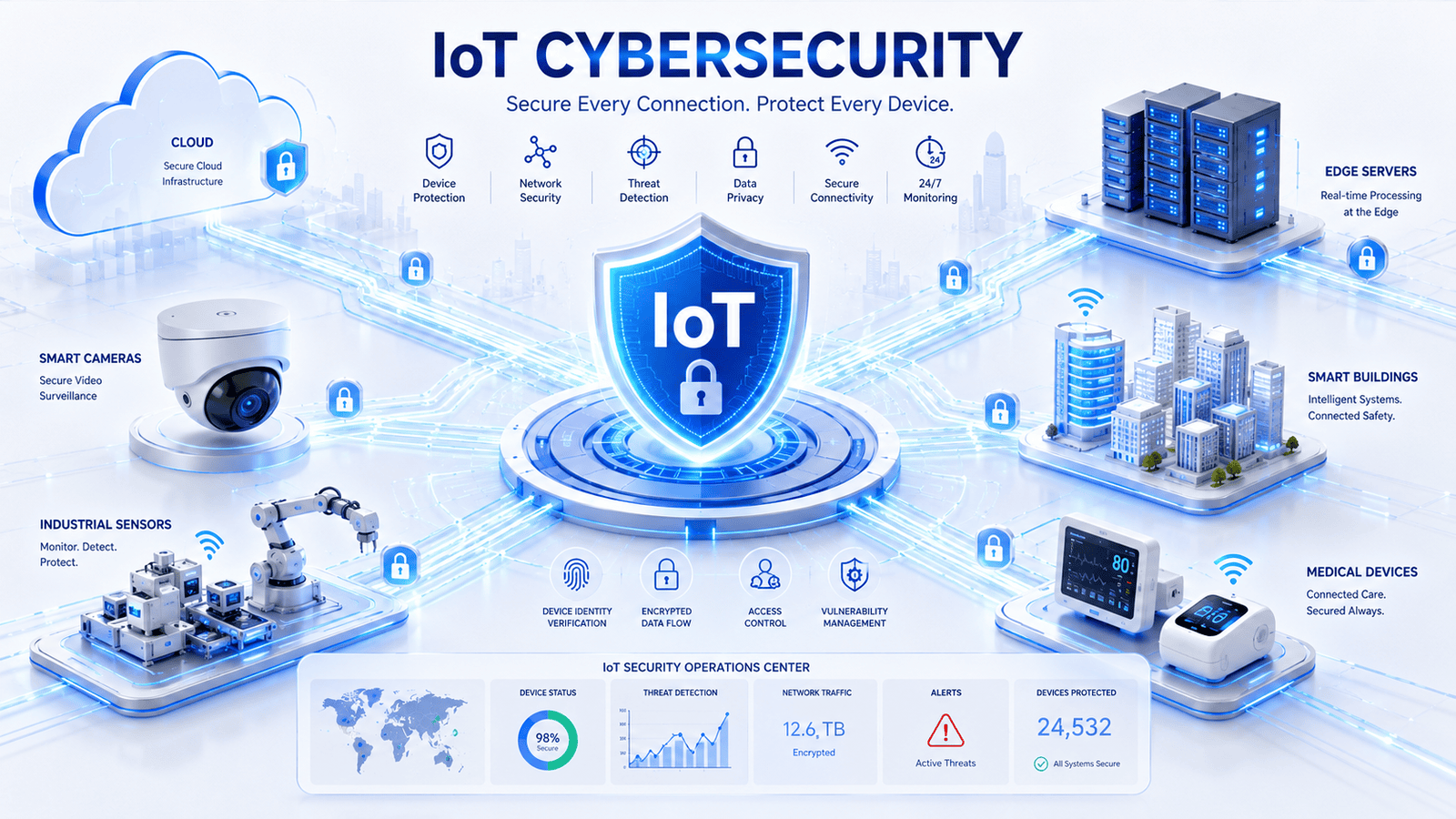
The attack surface most organizations are defending has quietly expanded far beyond laptops and email accounts. Connected cameras, access control systems, HVAC controllers, medical devices, point-of-sale terminals, and industrial sensors are all now standard parts of the modern network, and most of them were never designed with the same security assumptions as a corporate laptop. Many run outdated firmware, use default credentials that are rarely changed, and sit on the same network segment as sensitive business systems.
That combination makes IoT and edge computing environments an attractive target once an attacker has gained initial access, often through exactly the kind of phishing email covered earlier in this blog. A compromised employee credential can be used to move from an inbox to the network, and from the network to a connected device that nobody is actively monitoring. From there, attackers can establish long-term persistence that's difficult to detect since IoT devices rarely show up in traditional endpoint security tools. Purpose-built IoT solutions address this gap directly.
Rather than treating connected devices as an afterthought, dedicated IoT solutions bring the same principles applied to laptops and servers, network segmentation, access control, activity monitoring, and firmware management, to devices that were previously invisible to the security team. Segmentation alone makes a significant difference: isolating IoT devices onto their own network zones means that even if one is compromised, it can't be used as a stepping stone toward core business systems.
Key Challenges When Implementing Email Security at Scale
Implementing email protection for a small team is straightforward. Doing it across a distributed organization with multiple domains, remote workers, cloud platforms, and connected devices is a different challenge entirely.
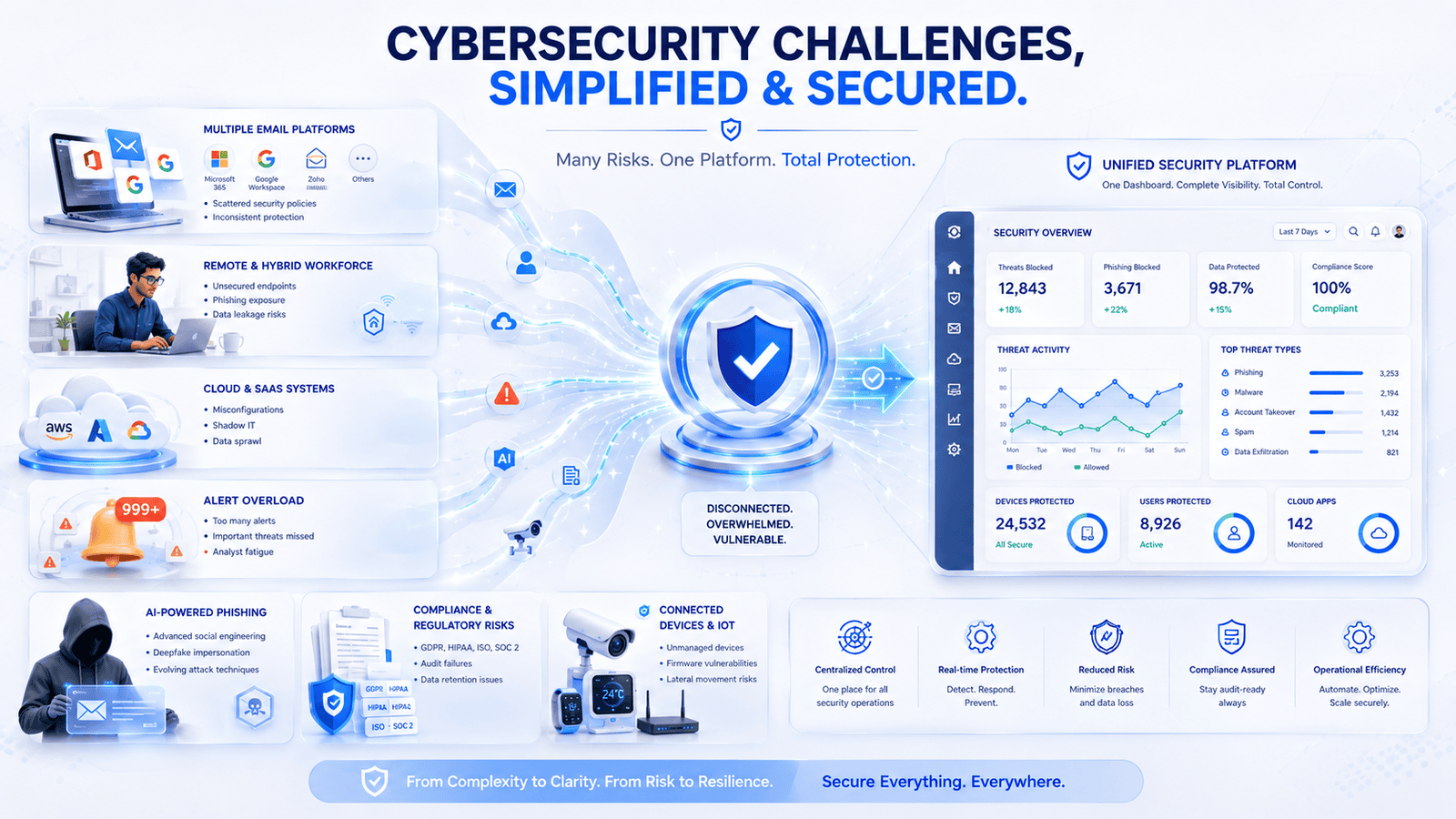
Scaling email security introduces challenges a small team rarely faces. Running multiple email platforms, such as Microsoft 365, Google Workspace, and legacy mail servers, creates policy gaps between systems unless organizations adopt centralized policy management and unified monitoring through solid IT infrastructure management. Untracked assets and devices give attackers an easy target, since IT teams can't secure what they don't know exists, which is why a live, current asset inventory matters so much. High alert volumes create fatigue, burying real incidents in noise unless detection thresholds are tuned and triage workflows are in place. Phishing tactics keep evolving, with AI-generated messages increasingly able to bypass static rule sets, making continuous policy updates and threat intelligence feeds essential. A single successful phishing incident can also trigger regulatory reporting duties, which is where proactive compliance monitoring and well-documented controls protect the organization. And with connected devices now a routine part of most networks, gaps in IoT solutions leave attackers a quiet path around otherwise strong email and endpoint defenses. Training alone can't guarantee consistent human behavior either, so the strongest programs pair employee education with technical controls that don't depend on people getting it right every time.
How Delphi Infotech Approaches Email Phishing Protection
Delphi Infotech's approach starts with a simple position: phishing protection is not a product you buy once and configure. It's an ongoing discipline that connects technical controls, trained people, and tested processes across your entire technology footprint.
Our partners gain access to a coordinated set of protections:
Email Security Solutions, Gateway-level filtering, sender authentication enforcement, URL sandboxing, and anti-impersonation policies configured to your mail environment.
IT Infrastructure Management: IT infrastructure management ongoing monitoring and management of the servers, networks, and systems that keep operations running, so unusual activity gets caught early.
Compliance Monitoring: compliance monitoring continuous tracking of controls and documentation against the frameworks your organization is required to meet.
IoT Solutions: IoT solutions security and management extended to connected devices and edge computing environments, not just laptops and inboxes.
“Partnership with Delphi Infotech means gaining access to expert cybersecurity support and training.”, Delphi Infotech
How to Get Started Protecting Your Organization Today
You don't need to overhaul everything at once. Start with the controls that produce the highest risk reduction for the least complexity.
Deploy SPF, DKIM, and DMARC on every domain your organization sends email from.
Enable MFA across all email accounts and business applications, prioritizing administrator accounts first.
Configure anti-phishing policies within your existing email platform. Turn on impersonation protection and safe-links scanning.
Run a phishing simulation to establish a baseline and identify which teams need the most focused training.
Strengthen IT infrastructure management so you have real-time visibility into the servers, networks, and endpoints across your environment.
Extend visibility to connected devices with dedicated IoT solutions.
Put ongoing compliance monitoring in place so a security incident doesn't turn into a reporting scramble.
Engage a cybersecurity and IT infrastructure management partner to review your current configuration, close policy gaps, and manage ongoing monitoring.
Key Takeaways
- Phishing is the top entry point for cyber incidents, and technical controls like SPF/DKIM/DMARC, gateway filtering, and MFA form the first line of defense.
- Email security should never operate in isolation, connecting it to IT infrastructure management, compliance monitoring, and IoT solutions closes the gaps attackers rely on.
- Strong infrastructure oversight lets your team detect and contain lateral movement fast, before a single phished credential turns into a full network breach.
- Ongoing compliance monitoring ensures a phishing incident doesn't turn into an unplanned regulatory event, since documentation stays current instead of being reconstructed after the fact.
- IoT and edge devices are increasingly used to establish persistence after a phishing attack, making dedicated IoT security essential rather than optional.
- The strongest defense pairs technical controls with trained employees and tested incident response plans.
Frequently Asked Questions
How can email phishing be prevented?
Preventing email phishing requires a combination of technical controls and user training. Deploy email authentication protocols (SPF, DKIM, DMARC), enable MFA on all accounts, configure anti-phishing policies within your email platform, and run regular phishing simulations with your team.
What are the top best practices for avoiding phishing attacks?
The highest-impact practices are enabling multi-factor authentication on all accounts, deploying email authentication protocols to block spoofed senders, and running regular phishing awareness training. Pairing these with strong IT infrastructure management and compliance monitoring closes the gaps that email controls alone can't cover.
Why does email security need to connect to IT infrastructure management?
Because a successful phishing attempt rarely stays contained to email. It becomes a network, device, or data problem within minutes. Strong IT infrastructure management gives your team the visibility to spot and contain that fallout before it spreads across servers, endpoints, and cloud workloads.
How often should compliance monitoring happen?
Compliance monitoring works best as a continuous practice rather than an annual event. Ongoing compliance monitoring tracks controls, access permissions, and documentation in real time, so drift is caught as it happens and audit or breach-reporting deadlines don't trigger a scramble.
How do IoT devices factor into phishing risk?
Attackers who gain a foothold through a phished credential often move toward less-monitored connected devices to establish persistence. Purpose-built IoT solutions extend the same visibility and access controls to those devices that you'd apply to laptops and servers.
Which are common ways to prevent email phishing attacks?
Common prevention methods include email gateway filtering, sender authentication (SPF/DKIM/DMARC), multi-factor authentication, URL sandboxing, anti-impersonation policies, phishing simulations, and ongoing compliance monitoring to catch post-breach exposure.