
Are Indian organisations genuinely equipped to detect a breach that is already in progress, or are they relying on security architectures designed for a threat landscape that no longer exists?
Over 265 million malware detections have been recorded across India’s enterprise environments, with ransomware-as-a-service victims rising globally by 53% in 2025 and supply chain attacks emerging as the preferred entry point into India’s BFSI sector. State-sponsored campaigns have compounded the picture: the India Cyber Threat Report 2026 documents 25 major global and regional cyber campaigns in 2025, including Operation Sindoor, a state-sponsored APT36 and SideCopy operation combining cyber espionage, data theft, and digital disruption.
The Scale of the Threat: India’s Cybersecurity Inflection Point
Understanding why this triad matters begins with understanding what Indian enterprises are actually facing. India’s cybersecurity market reached USD 11.3 billion in 2025 and is projected to reach USD 44.0 billion by 2034 at a CAGR of 15.46%, a trajectory driven not by opportunity alone, but by the compounding urgency of a threat environment that has fundamentally shifted in character.
Cybercriminals, empowered by AI and automation, now launch attacks in hours instead of months, making them faster, stealthier, and more persistent than at any prior point. Traditional defences, perimeter firewalls, signature-based antivirus, periodic vulnerability scans, were architected for a world of static network boundaries and known malware families. Neither condition applies to enterprises in India in 2026.

Network Security: Building a Defence That Extends Beyond the Perimeter
The first pillar of any coherent enterprise security strategy is network security.Modern network security encompasses intrusion prevention systems (IPS), network access control (NAC), DDoS mitigation, secure web gateways, data loss prevention (DLP), network penetration testing, and patch management, all operating in concert to control the flow of traffic, enforce access policies, and detect anomalous behaviour at the infrastructure layer.
India’s network security market reached USD 1.5 billion in 2025 and is projected to reach USD 4.8 billion by 2034, exhibiting a CAGR of 13.78%, driven by the growing frequency and sophistication of cyber threats including malware, ransomware, and phishing attacks. This growth reflects an enterprise awakening to a fundamental reality: the traditional perimeter has dissolved. Hybrid workforces, cloud-first infrastructure strategies, and multi-vendor SaaS ecosystems mean that the network surface requiring protection is distributed, dynamic, and largely invisible to legacy monitoring tools.
Zero Trust Architecture (ZTA) has emerged as the governing principle in response: no user, device, or workload is inherently trusted, and continuous verification is enforced at every layer. Paired with network segmentation, organisations can dramatically reduce the blast radius of any breach that does penetrate initial defences. Intrusion Prevention Systems operate inline in the network traffic flow to detect and block malicious packets in real time before they reach their targets, a distinction that becomes significant when adversaries are operating at machine speed.

EDR: Closing the Endpoint Blind Spot
If the network is the highway, endpoints are the destinations, and they are precisely where most breaches ultimately manifest. Endpoint Detection and Response (EDR) addresses this problem by providing continuous, behavioural monitoring of every endpoint, enabling real-time detection of threats that have never been seen before, including fileless malware, living-off-the-land attacks, and zero-day exploits that signature-based tools are structurally incapable of catching.
The global EDR market is projected to expand from USD 5.11 billion in 2025 to USD 18.68 billion by 2031, registering a CAGR of 24.16%, driven by the commercialisation of ransomware toolkits, a pivot to cloud-delivered security, and the steady transformation of EDR from an optional upgrade into a line-item security requirement.
The mechanism that makes EDR distinctively valuable is behavioural analytics. Rather than matching file hashes against a known-bad database, EDR solutions model the normal behaviour of processes, users, and system calls on each endpoint, and flag deviations that indicate compromise. When a legitimate productivity application spawns an unexpected child process, or when a user account begins accessing files at an unusual hour, EDR detects the anomaly and can contain the affected endpoint automatically.

SOC Services: The Intelligence Layer That Connects the Dots
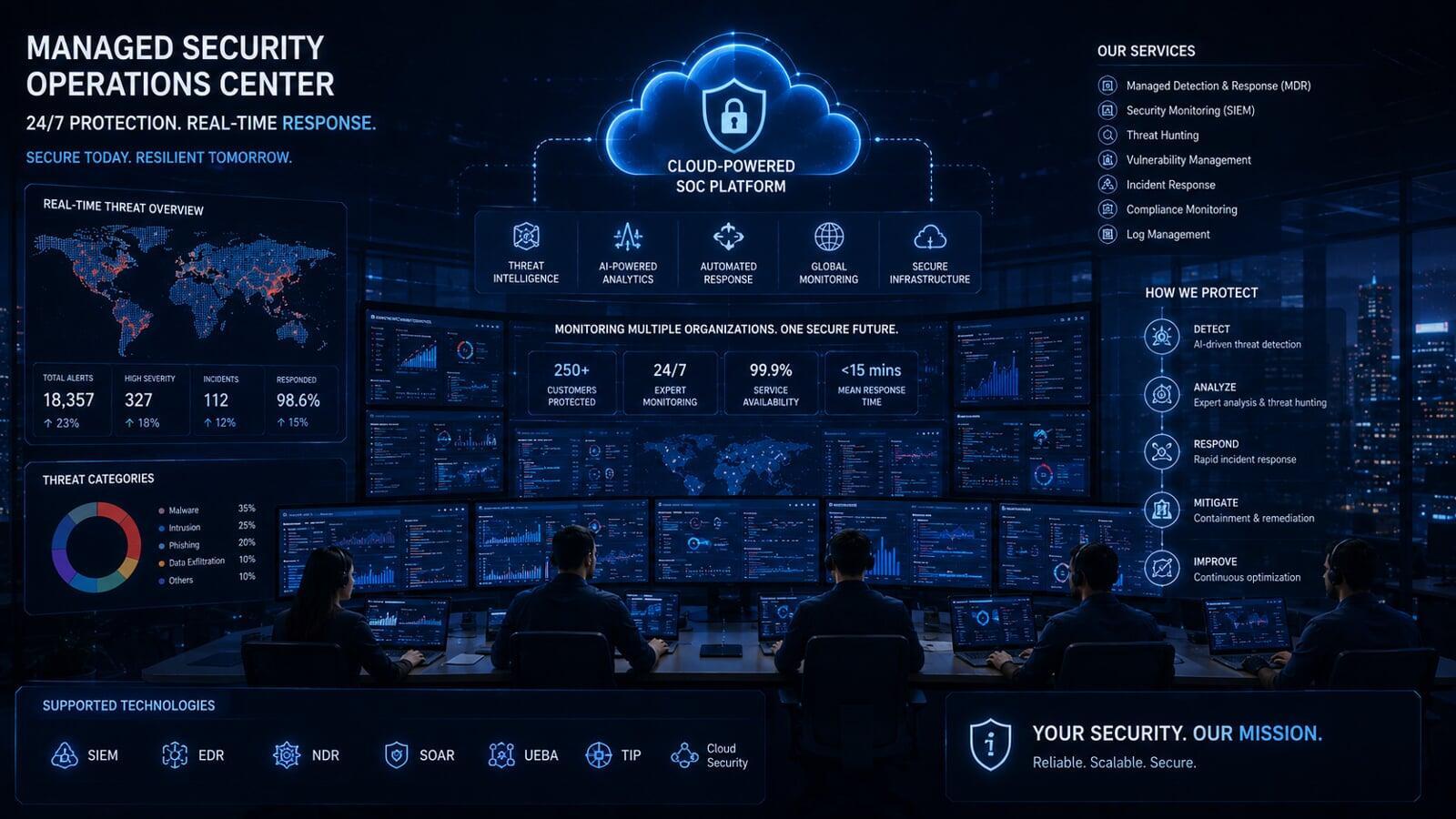
A Security Operations Centre (SOC) is the operational hub of enterprise security. SOC services integrate Security Information and Event Management (SIEM), Security Orchestration Automation and Response (SOAR), and User and Entity Behaviour Analytics (UEBA) into a unified platform, staffed by analysts operating on a 24/7 basis to monitor, investigate, and respond to incidents as they emerge.
Machine learning algorithms are being deployed in SOCs to analyse vast volumes of log data and network traffic, helping detect advanced persistent threats and zero-day vulnerabilities that traditional systems may miss. Log management and SIEM solutions hold the largest market share in India’s cybersecurity landscape, as enterprises focus on centralised visibility, real-time threat monitoring, and compliance reporting.

How the Three Pillars Function as an Integrated System
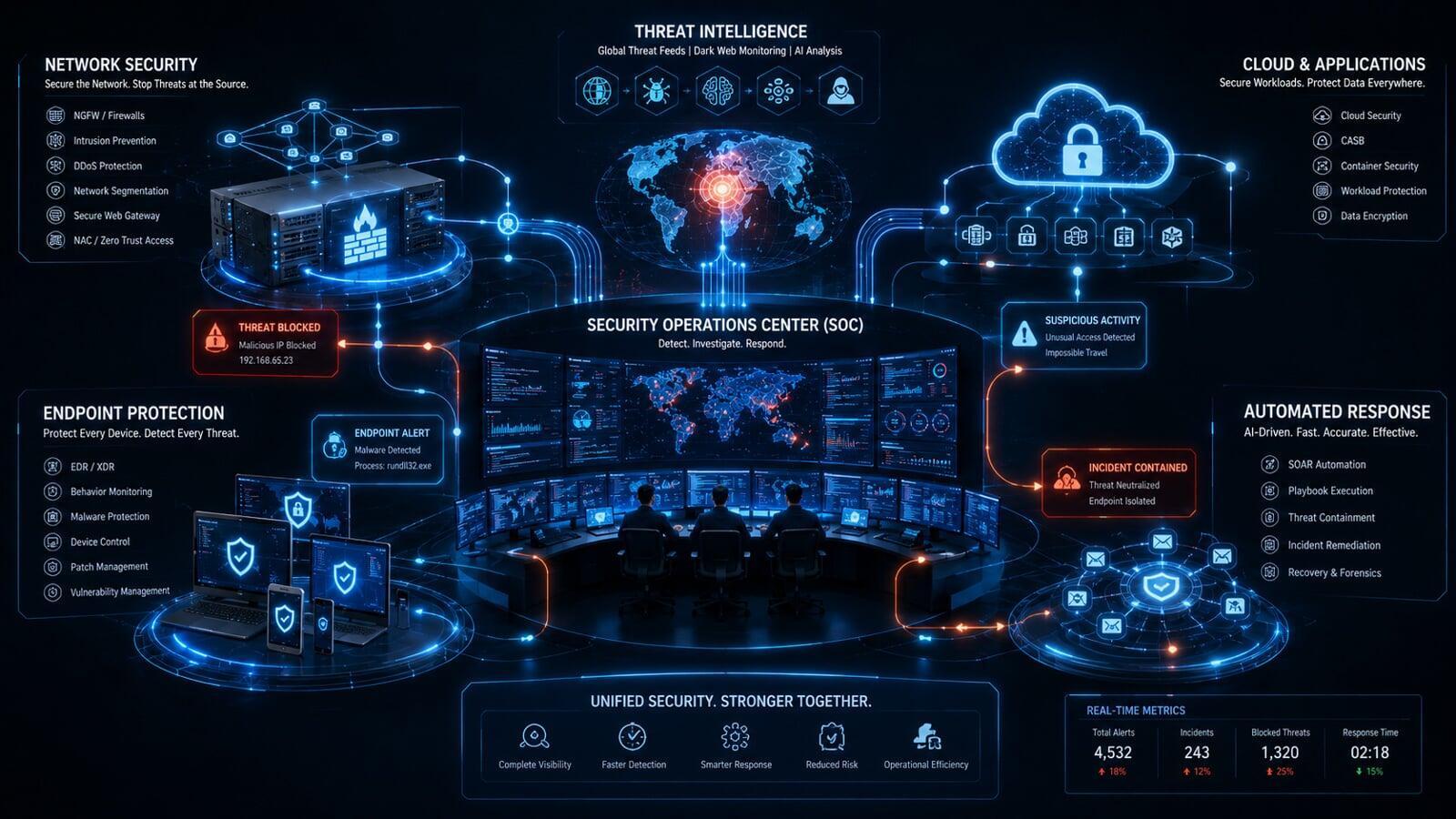
The transformative insight is not that network security, EDR, and SOC services are individually valuable, it is that their integration creates a detection-and-response capability substantially greater than the sum of its parts.
Network security controls the attack surface and generates traffic-layer telemetry. EDR fills this blind spot at the endpoint layer, providing granular visibility into process behaviour, memory activity, file system changes, and lateral movement that network tools cannot observe. The SOC receives EDR alerts, correlates them with network telemetry, enriches them with threat intelligence, determines the scope of the incident, and executes a response playbook, all within a timeframe that manual investigation could never match.
The DPDPA Dimension: Compliance as a Security Driver
India’s regulatory environment is now a direct driver of security architecture decisions. The DPDPA’s six-hour CERT-In notification requirement makes Mean Time to Detect (MTTD) a regulatory metric. An organisation that takes 72 hours to identify a breach, the historical enterprise average1, is not merely operationally compromised; it is non-compliant. The integrated network security, EDR, and SOC architecture is the mechanism through which MTTD is reduced from days to minutes.

Managed Security Services: Making Enterprise-Grade Capability Accessible
One of the most consequential developments in India’s security market over the past 18 months has been the democratisation of enterprise-grade security through managed service delivery models. EDR-as-a-Service is increasingly being adopted by SMEs seeking affordable protection without specialist in-house SOC teams, and buyers are increasingly favouring measurable MTTD and MTTR outcomes alongside co-managed SOC operations over simple tool procurement.
Conclusion
The Indian enterprise threat landscape in 2026 is characterised by adversaries that are better resourced, more automated, and more patient than the defences most organisations have deployed to counter them. Network security, EDR, and SOC services represent the most coherent defensive response available to enterprises operating at scale in this environment. Each layer compensates for the structural limitations of the others. Together, they deliver a detection and response capability that can absorb sophisticated attacks, contain their spread, minimise dwell time, and generate the evidentiary record that both regulators and boards will increasingly demand.

Key Takeaways
- India’s cybersecurity market is projected to reach USD 44 billion by 2034, reflecting the scale of both the threat and the opportunity.
- Network security controls the attack surface through IPS, NAC, DLP, patch management, and Zero Trust enforcement, but is blind to threats originating from legitimate credentials.
- EDR closes the endpoint blind spot through behavioural analytics, real-time containment, and forensic telemetry that signature-based tools cannot provide.
- SOC services correlate signals from all layers, apply threat intelligence, and execute structured response playbooks, converting raw telemetry into closed-loop incident management.
- The integration of all three pillars is what reduces MTTD to minutes; any one pillar operating in isolation leaves exploitable gaps.
- India’s DPDPA mandates six-hour breach notification to CERT-In, making MTTD a regulatory metric and the SIEM/EDR audit trail a compliance asset.
- Managed SOC and EDR-as-a-Service models have made this integrated capability economically accessible to Indian mid-market and SME organisations.
Frequently Asked Questions
Q: What is the difference between IDS and IPS in the context of network security?
A: An Intrusion Detection System (IDS) monitors network traffic and generates alerts when suspicious patterns are identified, but takes no autonomous action. An Intrusion Prevention System (IPS) operates inline in the traffic flow and actively blocks or terminates malicious sessions in real time, before the threat reaches its target. For most enterprise environments in India, IPS represents the more operationally appropriate deployment.
Q: How does EDR differ from traditional antivirus software?
A: Traditional antivirus relies on a database of known malware signatures, meaning it can only catch attacks that have been previously documented. EDR monitors the behavioural patterns of processes, users, and system calls on each endpoint continuously, identifying anomalies regardless of whether the threat has been seen before. EDR also provides forensic telemetry, a full audit trail of what occurred on an endpoint before, during, and after an incident.
Q: What does a SOC actually do on a day-to-day basis?
A: A SOC monitors security alerts generated by SIEM, EDR, and network tools around the clock, triaging events to distinguish genuine incidents from false positives. When a genuine incident is confirmed, SOC analysts investigate its scope, execute a response playbook to contain and remediate the threat, and document the incident for compliance and forensic purposes. Advanced SOCs also conduct proactive threat hunting.
Q: Is a managed SOC suitable for mid-sized Indian enterprises, or is it primarily an enterprise-grade solution?
A: Managed SOC and SOCaaS models are specifically designed for organisations that cannot justify the capital investment of a 24/7 in-house security operations team. For Indian mid-market enterprises, typically those with 200 to 2,000 employees, a managed SOC delivers analyst coverage, SIEM technology, and incident response capability at a cost structure proportionate to the organisation’s scale.
Q: How does the DPDPA affect an organisation’s obligations around security monitoring?
A: The DPDPA requires organisations to implement reasonable technical and organisational safeguards to protect personal data, notify CERT-In within six hours of a significant breach, and maintain documented evidence of their security practices. Continuous monitoring through an integrated SOC and SIEM platform is the primary mechanism through which organisations can meet the six-hour notification threshold.
Strengthen your cybersecurity posture with integrated Network Security, EDR, and SOC Services from Delphiinfo.com today.