
Meta Description: How can I protect my company's data from accidental loss or leaks? Get actionable data loss prevention, endpoint, and email security strategies from Delphi Infotech.
Every business owner eventually asks the same question: How can I protect my company's data from accidental loss or leaks? It is not paranoia. It is the right question at the right time. Data is your most valuable asset, and the risks surrounding it grow more complex every year as organizations adopt cloud platforms, remote work, and an expanding mix of connected devices. This blog walks you through the real causes of data loss, the strategies that work, and exactly how to build a layered protection program your business can count on, one that covers people, processes, and the technology stack underneath them.
Data protection is no longer a back-office IT concern. It touches every department, every employee, and increasingly, every connected asset across your operations, including industrial IoT solutions that now sit at the edge of corporate networks. Understanding where your data lives, how it moves, and who can touch it is the foundation everything else in this guide builds on.What Causes Data Loss and Leaks, and Why It's Mostly Human
The single most important thing to understand about data loss is that most of it starts with people, not technology. According to Verizon's 2024 Data Breach Investigations Report, the human element, including honest employee mistakes, accounts for 68 percent of all data breaches. A misdirected email, an improperly shared file, a weak password reused across accounts: these are the events that open the door to far bigger problems.
External risks are real too, and they are growing alongside the number of connected systems a typical company now operates. But your data protection strategy has to address internal behavior just as seriously as it addresses outside attacks. A firewall does little to stop an employee from emailing a spreadsheet of customer records to the wrong address, and no amount of perimeter security helps once a misconfigured cloud folder is sitting open to the public internet.
Common causes of data loss and leaks include
- Accidental sharing: employees emailing sensitive files to the wrong recipient or uploading data to unsanctioned cloud apps.
- Phishing attacks: staff clicking malicious links that hand over login credentials.
- Unmanaged endpoints: laptops, mobile devices, and USB drives that carry data outside your controlled environment.
- Misconfigured cloud storage: publicly accessible folders that were never meant to be public.
- Departing employees: data exfiltration when team members leave the company.
- Unpatched systems and devices: known software vulnerabilities that go unaddressed for months, giving attackers an open path into your environment.
- Unmonitored connected devices: sensors, controllers, and other connected hardware that fall outside traditional IT oversight and quietly expand your exposure.
Knowing these causes is step one. Fixing them is what the rest of this blog is about.
Core Strategies to Protect Your Company's Data
The most effective data protection programs layer multiple controls so that no single point of failure exposes your business. A single tool, however sophisticated, cannot account for every way data can leave an organization. Layered protection means that if one control fails or is bypassed, another is in place to catch the problem before it becomes a breach.
Here is how to build that layer by layer.
1. Classify Your Data First
You cannot protect what you have not identified. Start by inventorying every category of data your business holds: customer records, financial information, intellectual property, employee data, legal documents, and increasingly, operational data generated by connected equipment. Then rank each category by sensitivity and the impact a leak would have on your business, your customers, and your regulatory standing.
The FTC's guidance on protecting business information, summarized via Business.com's security practices article, recommends keeping only the data you genuinely need and disposing of the rest through documented processes. Reducing the volume of sensitive data you store directly reduces your exposure. Classification also tells you where to focus your highest-priority controls first, rather than spreading limited resources evenly across data that carries disparate levels of risk.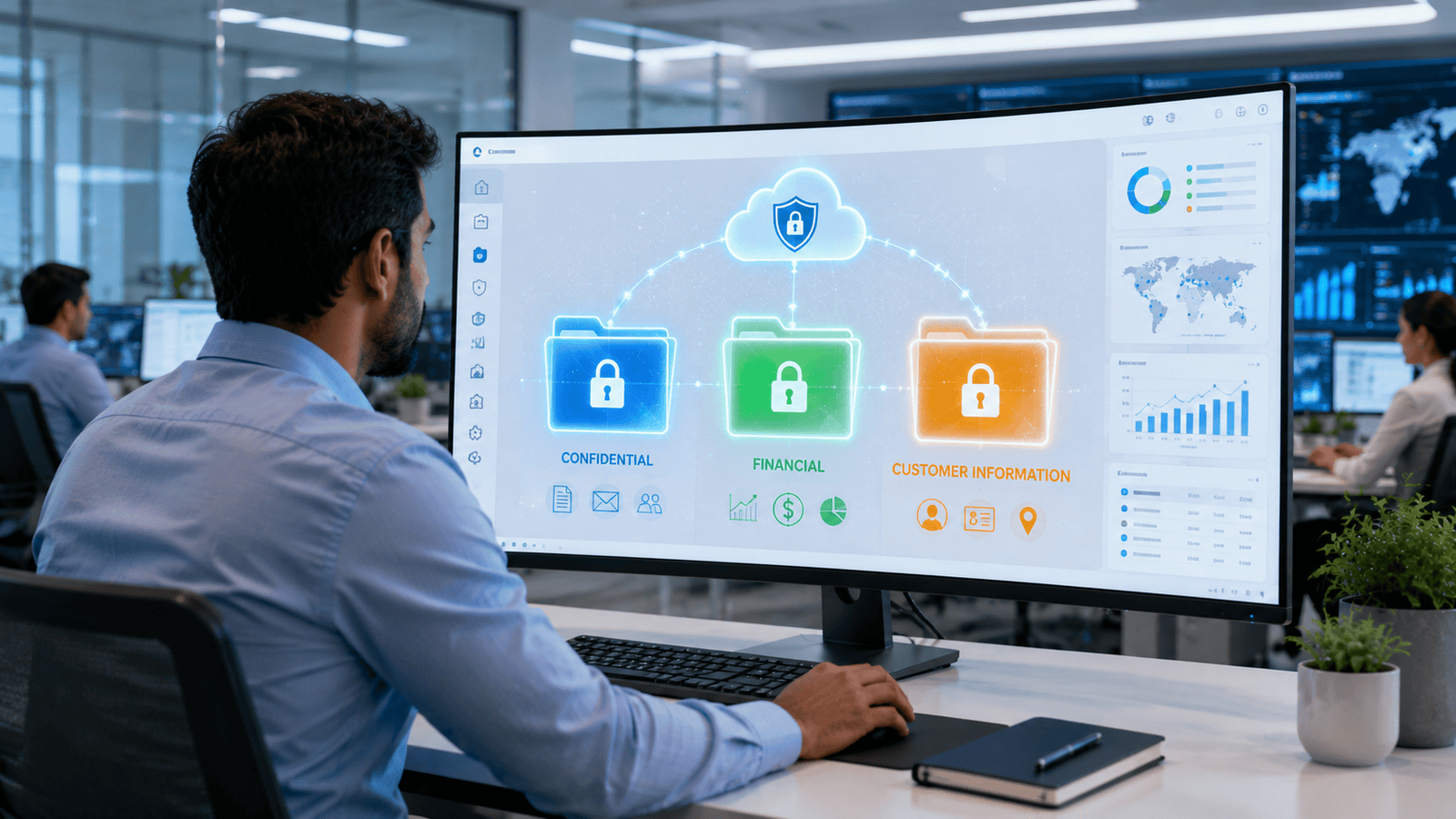
2. Deploy Data Loss Prevention Solutions
Data Loss Prevention (DLP) software monitors, detects, and blocks unauthorized movement of sensitive data, whether it is leaving via email, cloud upload, or USB transfer. DLP tools operate on policy rules you define: flagging any outbound email containing a Social Security number, or blocking file transfers to personal storage accounts the moment they are attempted.
3. Lock Down Endpoints and Connected Assets
Every device that touches your company's data is a potential exit point. Laptops taken home, smartphones syncing with corporate email, contractor machines with broad network access: each one is a risk if left unmanaged. This category has expanded significantly as manufacturing, logistics, and facilities teams adopt connected sensors, controllers, and gateways that sit outside the traditional IT perimeter.
4. Keep a Live Inventory With Asset Management
A surprising number of data leaks trace back to a simple gap: nobody knew the device existed. A forgotten server, a retired laptop still holding a login session, a contractor's tablet that was never deprovisioned. You cannot secure assets you do not know you have, and inventories built once a year in a spreadsheet are out of date within weeks.
Delphi Infotech's asset management solutions give IT teams a continuously updated view of every device, application, and connected system across the organization. That live inventory is the foundation for every other control in this blog: you cannot apply DLP policies, endpoint protections, or patches consistently if you do not know precisely what exists in your environment. Strong asset management turns data protection from a periodic audit exercise into an ongoing, accurate practice.
5. Protect Email as a First Priority
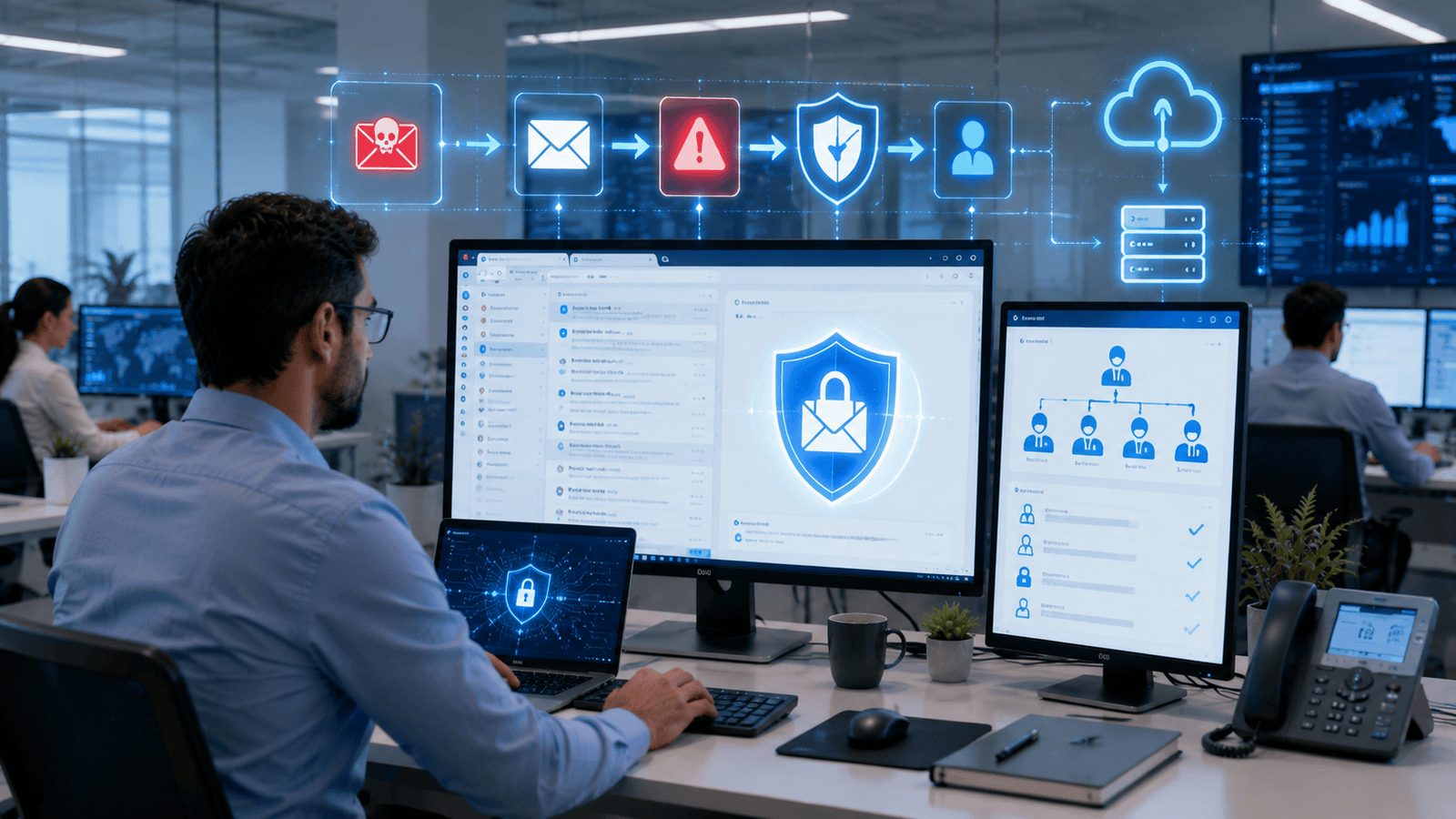
Email is the number one channel through which sensitive data leaves organizations unintentionally. A single misdirected attachment can expose client records, financial projections, or proprietary formulas. It is also the primary channel for phishing attacks that harvest credentials and give outsiders access to everything behind your login screen.
6. Control Access Strictly
Not everyone on your team needs access to everything. Role-based access control (RBAC) ensures that employees can only reach the data relevant to their function. An accounts payable clerk does not need the CEO's strategic documents. A customer service representative does not need the source code repository.
Apply the principle of least privilege: grant access at the minimum level required, review permissions quarterly, and revoke access immediately when an employee changes roles or leaves the company. Pairing access reviews with an accurate asset inventory makes this far easier since you can map exactly which accounts touch which systems instead of guessing.
7. Run Regular Vulnerability Assessments and Stay Current on Patching
Your technical defenses degrade over time as software ages, configurations drift, and new risks emerge. According to UpGuard, unpatched software vulnerabilities are a consistent entry point for data leaks, and many breaches exploit flaws that had known fixes available for months before the incident actually occurred.
Delphi Infotech's Vulnerability Assessment Services identify those gaps before someone else does. Regular assessments give you a current picture of your risk posture and a prioritized remediation list, so your team works on the issues that matter most, in the right order. That remediation list is only useful if it gets acted on quickly, which is where patch management comes in. Consistent, timely patch management closes known vulnerabilities across servers, endpoints, and connected devices before attackers can exploit them, turning assessment findings into actual risk reduction rather than a list that sits unaddressed.
8. Train Your Team, Repeatedly
Training is not a box to check once a year. It is an ongoing part of your data protection culture. Your employees are your first line of defense, and they need to know what phishing looks like, how to handle sensitive data correctly, and what to do if they suspect a breach.
Partnership with Delphi Infotech means gaining access to expert cybersecurity support and training programs designed to build real awareness, not just compliance theater. Scenario-based exercises that mimic real phishing attempts and real data-handling decisions consistently outperform generic annual modules because they build judgment rather than rote memorization.How to Choose the Right DLP Vendor for Your Business
Selecting a DLP solution is not one-size-fits-all. The right tool depends on the types of data you hold, your compliance obligations, and your existing infrastructure, including any operational technology or connected devices already running in your environment. Here is what to evaluate:
- Data type coverage: does it recognize PII, financial data, intellectual property, and healthcare records?
- Integration: does it work with your email platform, endpoint management tools, and asset inventory?
- Policy flexibility: can you customize rules for your specific business needs and risk profile?
- Alerting and reporting: does it give your team actionable, real-time notifications instead of noise?
- Compliance support: does it help you meet HIPAA, PCI-DSS, SOC 2, or GDPR requirements?

The Real Cost of Getting This Wrong
IBM's 2024 Cost of a Data Breach Report, referenced via Business.com, puts the global average cost of a data breach at $4.88 million, with each breached record costing approximately $173. For small and medium-sized businesses, a breach of that magnitude is not just expensive. It can be fatal to operations, draining cash reserves, damaging customer trust, and triggering regulatory scrutiny that lingers long after the technical incident is resolved.
Verizon's 2024 Data Breach Investigations Report found that the human element, including errors, misuse of privilege, use of stolen credentials, and social engineering, was a contributing factor in the majority of breaches studied.
Putting the Layers Together: A Practical Starting Point
If you are starting from scratch, resist the urge to implement everything at once. A practical sequence looks like this: begin with a complete asset inventory so you know exactly what exists in your environment, then classify the data living on those assets by sensitivity. From there, prioritize the controls that address your highest-risk gaps first, typically email security and endpoint management, since these channels carry the highest volume of accidental exposure. Layer in DLP policies once you understand your data flows, then build out a recurring cadence of vulnerability assessments and patch management to keep pace with new risks as they emerge.

Conclusion
Protecting your company's data requires action on multiple fronts: classifying what you hold, maintaining accurate asset visibility, training your people, deploying DLP tools, locking down endpoints and connected devices, protecting email, and running regular assessments paired with consistent patch management to stay ahead of emerging risks. No single control is enough on its own, but layered together, they create a defense that is genuinely hard to breach.
Delphi Infotech provides cybersecurity solutions tailored to protect businesses from evolving risks, with a focus on proactive defense and data integrity. Whether you are starting from scratch or tightening an existing program, our team is ready to help you build something that works.
Talk to the Delphi Infotech team today. Protect your data before a leak forces you to.
Key Takeaways
- Most data loss and leaks start with human error, not external attackers, so internal controls matter as much as perimeter defenses.
- Data classification is the starting point; you cannot protect data you have not identified and ranked by sensitivity.
- DLP software, endpoint management, and email security work best as connected layers, not standalone tools.
- Accurate, continuously updated asset management is the foundation that makes every other control consistent and reliable.
- Timely patch management closes known vulnerabilities before attackers can exploit them.
- Industrial IoT solutions extend security discipline to connected operational devices that traditional IT tools often miss.
- Ongoing, scenario-based employee training has a measurable, direct impact on reducing data leaks.
- The average cost of a data breach far exceeds the cost of proactive protection, making prevention the financially sound choice.
Frequently Asked Questions
Q: What is the difference between data loss and a data leak?
A: Data loss means data is destroyed or becomes inaccessible, often due to hardware failure, accidental deletion, or ransomware. A data leak means sensitive information is exposed to unauthorized parties, typically through misconfiguration, insider error, or a breach. Both require different but overlapping controls.
Q: Do small businesses really need DLP software?
A: Yes. Research from ConnectWise found that 94 percent of SMBs experienced a cyberattack in 2024, and many of those involved data exposure. DLP tools have become accessible for businesses of all sizes, and the cost of not having one consistently outweighs the investment.
Q: How often should we run vulnerability assessments and patch management cycles?
A: Most security frameworks recommend at least quarterly assessments, with additional scans after major changes to your infrastructure. Patch management should run on a continuous cycle rather than a fixed schedule since new vulnerabilities are disclosed constantly. High-risk industries such as healthcare and finance typically require more frequent testing to meet compliance standards.
Q: Can employee training actually reduce data leaks?
A: Absolutely. Since the human element drives the majority of breaches, improving how your team identifies and handles risky situations has a direct, measurable impact on your risk exposure. Regular, scenario-based training works significantly better than annual compliance-only modules.
Q: What data should we prioritize protecting first?
A: Start with personally identifiable information, financial records, and any intellectual property that represents your competitive advantage. These categories carry the highest regulatory and reputational risk if exposed.
Q: Does asset management really affect data security, or is it just an IT bookkeeping task?
A: It directly affects security. Most security controls, including DLP, endpoint protection, and patch management, can only be applied consistently if you have an accurate, current inventory of every device and application in your environment. Without that visibility, gaps go unnoticed until they are exploited.
Q: How does IoT security fit into a broader data protection strategy?
A: Connected industrial devices, sensors, and edge systems increasingly generate, store, and transmit data alongside traditional IT infrastructure. Without dedicated industrial IoT solutions, these devices often sit outside standard endpoint management, creating blind spots that attackers can exploit to reach the rest of your network.
Don't wait for a data leak to expose your business, partner with Delphi Infotech for end-to-end DLP, email security, and vulnerability management built to protect what matters most. Talk to a Delphi Security Expert Today