
Indian organisations face 3,195 weekly cyberattacks on average. Discover how cyber risk management, data security solutions, and dark web monitoring services work together to protect your business in 2026.
Indian organisations now face an average of 3,195 cyberattacks every single week a figure that is 62% higher than the global average. In 2025 alone, CERT-In logged 29.44 lakh (nearly 2.94 million) cybersecurity incidents across the country. These are not abstract numbers from a distant threat landscape. They represent stolen customer databases, drained bank accounts, ransomed hospital records, and boardrooms scrambling to explain a breach to regulators, customers, and shareholders.
We have watched this threat landscape evolve first-hand, working alongside Indian businesses that are digitising faster than their security budgets can keep pace. What we consistently see is that organisations treat cybersecurity as three disconnected problems: risk assessment, data protection, and threat monitoring, when in reality, they are one continuous discipline.The Escalating Cyber Risk Landscape in India
India's rapid digital transformation has made it one of the most targeted markets in the world. The World Economic Forum's Global Risk Report 2026 now ranks cybersecurity as India's number one national risk, placing it ahead of economic downturns, climate-related disasters, and armed conflict. That single ranking should reframe how every Indian business leader thinks about security spending.
A few data points illustrate why we see this shift as permanent rather than cyclical:
CERT-In-reported incidents grew from 14.02 lakh in 2021 to 29.44 lakh in 2025 more than doubling in four years.
- The average global cost of a data breach in 2026 sits at roughly $4.88 million, while breaches in India average closer to $3.2 million, a figure that is rising even as the global weighted average dips.
- Security teams still take an average of 277 days to identify and contain a breach, nearly nine months during which attackers can move freely inside compromised networks.
We find that most organisations underestimate how these numbers compound. A breach detected in month nine has already had nine months to spread laterally, exfiltrate data, and quietly resurface on underground marketplaces. This is precisely the gap that structured cyber risk management is designed to close, and it is why we built our own risk mitigation and business continuity practice around continuous assessment rather than a once-a-year audit.
The sector-level data tells an equally important story. Education has seen a measurable rise in ransomware attacks; financial services remain a perennial target for credential-stuffing campaigns, and IT and software firms, the very companies building the tools everyone else depends on, recorded among the highest volumes of credential-theft attempts of any industry in 2026. No sector is exempt, and the organisations that assume "we are too small to be a target" are consistently the ones we see recovering from breaches months after the fact, rather than preventing them in the first place. Global cybersecurity spending is projected to rise by roughly 12.5%, approaching $240 billion, precisely because boards are recognising that the cost of inaction now outpaces the cost of a genuine security programme.
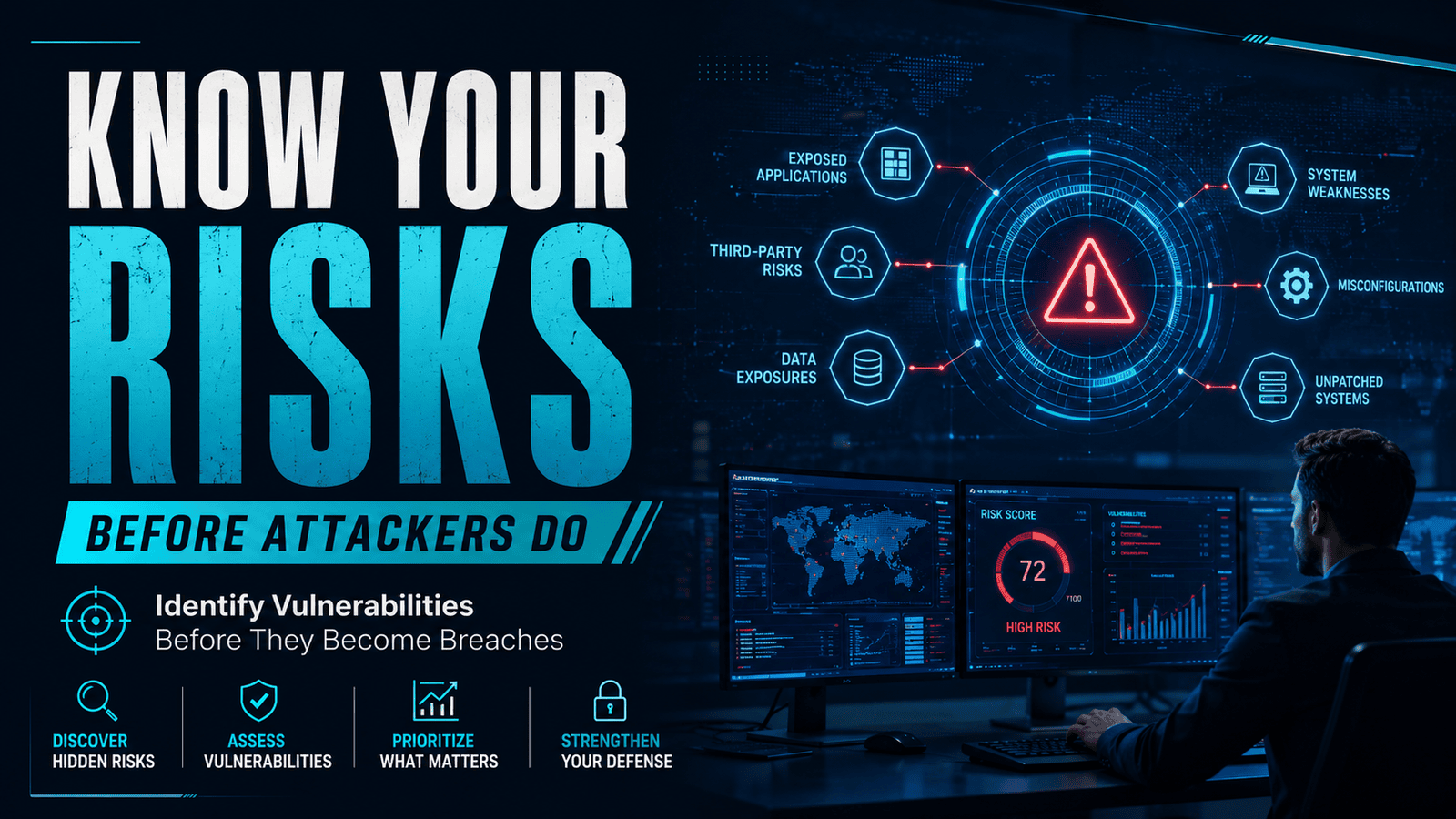
Why Cyber Risk Management Is No Longer Optional
Cyber risk management is the discipline of identifying, evaluating, and prioritising threats to an organisation's digital assets, then applying controls proportionate to the risk each asset carries. It is fundamentally different from generic IT security because it starts with business impact, not technology.
We approach this in three stages that Indian organisations of any size can adopt:
1. Asset and exposure mapping cataloguing every system, vendor connection, and data repository that could be a point of failure.
2. Threat and vulnerability prioritisation ranks risks by likelihood and business impact, rather than treating every alert as equally urgent.
3. Continuous review and business continuity planning because a risk register that is reviewed once a year is already outdated by the time the next audit rolls around.
The human element remains the common thread in most incidents. Industry research attributes somewhere between 74% and 95% of data breaches to human error, a misdirected email, a reused password, and an unpatched laptop. This is why our approach to risk mitigation and business continuity planning treats people, not just infrastructure, as a primary control point. Our clients typically begin with a risk mitigation and business continuity assessment before any technology is deployed because buying tools without understanding exposure is how security budgets get wasted.
Building a Cyber Risk Management Framework That Actually Works
A framework only earns its name if it survives contact with a real incident. We have found that the frameworks which hold up share four characteristics.
They are tiered by business function. Not every department carries the same risk. A finance team handling wire transfers needs tighter controls than an internal wiki.
They assign clear ownership. Every identified risk needs a named owner, not a shared inbox accountable for remediation timelines.
They are tested, not just documented. Tabletop exercises and simulated incidents reveal gaps that policy documents never will.
They are mapped to regulatory obligations. In India, this increasingly means alignment with the Digital Personal Data Protection (DPDP) Act 2023 and CERT-In's mandatory six-hour incident reporting window.
Organisations that adopt this kind of structured cyber risk management typically move from reactive firefighting to predictable, budgeted security operations within two to three quarters. That shift alone from "we'll deal with it when it happens" to "we already know what happens next" is often the single biggest return on a security investment.
We also encourage clients to separate risk acceptance from risk neglect. Not every identified risk needs an immediate technical fix; some can be formally accepted with executive sign-off if the cost of mitigation genuinely outweighs the exposure. What we push back on is the far more common pattern, where a risk is quietly left unaddressed simply because no one owns it. A properly maintained risk register, reviewed on a quarterly cadence alongside business continuity plans, turns cyber risk management from a compliance artefact into a genuine decision-making tool for leadership.
Data Security Solutions: The Foundation Beneath Every Control
If cyber risk management tells you where the exposure is, data security solutions are what actually close the gap. Data security is the set of technologies, policies, and processes that protect data throughout its lifecycle from creation and storage to transmission and eventual deletion.
We think about data security across three layers:
- Data at rest encryption for databases, file servers, and backups, so that a stolen drive or a misconfigured cloud bucket does not translate into a readable breach.
- Data in transit TLS encryption, secure VPNs, and email security gateways that prevent interception as data moves between systems and users.
- Data in use access controls, role-based permissions, and data loss prevention tooling that limit what an authenticated user can actually extract or share.
Indian regulators have made this layered approach a legal expectation, not just a best practice. Under the DPDP Act, organisations handling personal data must demonstrate reasonable security safeguards, and listed companies must disclose material cyber incidents to the BSE or NSE within 24 hours. Our data privacy and security compliance practice exists specifically to help organisations map these overlapping obligations DPDP, sector-specific RBI or IRDAI guidelines, and internal governance into one coherent control set rather than a patchwork of point solutions.
Why API and Endpoint Weaknesses Keep Fueling Indian Breaches
A recurring pattern in India's largest breaches, from compromised government portals to major e-commerce platforms, is poorly secured APIs and unmonitored endpoints. APIs that lack proper authentication, authorisation, or rate-limiting create a direct pipe into sensitive systems, while endpoints (laptops, mobile devices, IoT sensors) remain the easiest entry point for credential-stealing malware.
Seqrite Labs' India Cyber Threat Report 2026 recorded 265.52 million malware detections across more than 8 million endpoints in a single year, with trojans accounting for nearly 43% of all detections malware specifically engineered to harvest login credentials for resale. The IT and software sector alone accounted for over 2.76 million of those detections, a reminder that even the companies building security products are not immune.
This is exactly where robust data security solutions and disciplined access governance intersect. Rate-limited APIs, endpoint detection and response (EDR) tooling, and enforced least-privilege access all reduce the surface area attackers can exploit but only if they are implemented as a system, not a checklist of individually purchased tools.
Dark Web Monitoring Services: Your Early Warning System
Even the most disciplined organisations eventually have credentials exposed through a third-party vendor breach, a phishing campaign, or an employee reusing a personal password on a work account. This is where dark web monitoring services become essential rather than optional.
The scale of the underground credential economy is difficult to overstate. Current estimates put more than 15 billion stolen credentials in active circulation on dark web marketplaces and Telegram channels, with roughly 43% of employees at mid-sized companies having at least one leaked credential already available for purchase. Stolen access credentials remain the leading initial access vector for cyberattacks, implicated in roughly 22% of all intrusions.
For Indian enterprises specifically, this exposure is not theoretical. Karnataka and Maharashtra states with the densest concentration of IT firms recorded 11.64 million and 36.13 million malware detections respectively in 2026, numbers that translate directly into a steady supply of harvested credentials feeding underground marketplaces. Our dark web monitoring tools continuously scan Tor networks, paste sites, criminal forums, and closed Telegram channels for any mention of an organisation's domains, email addresses, or leaked credential sets, alerting security teams before those credentials are weaponised.
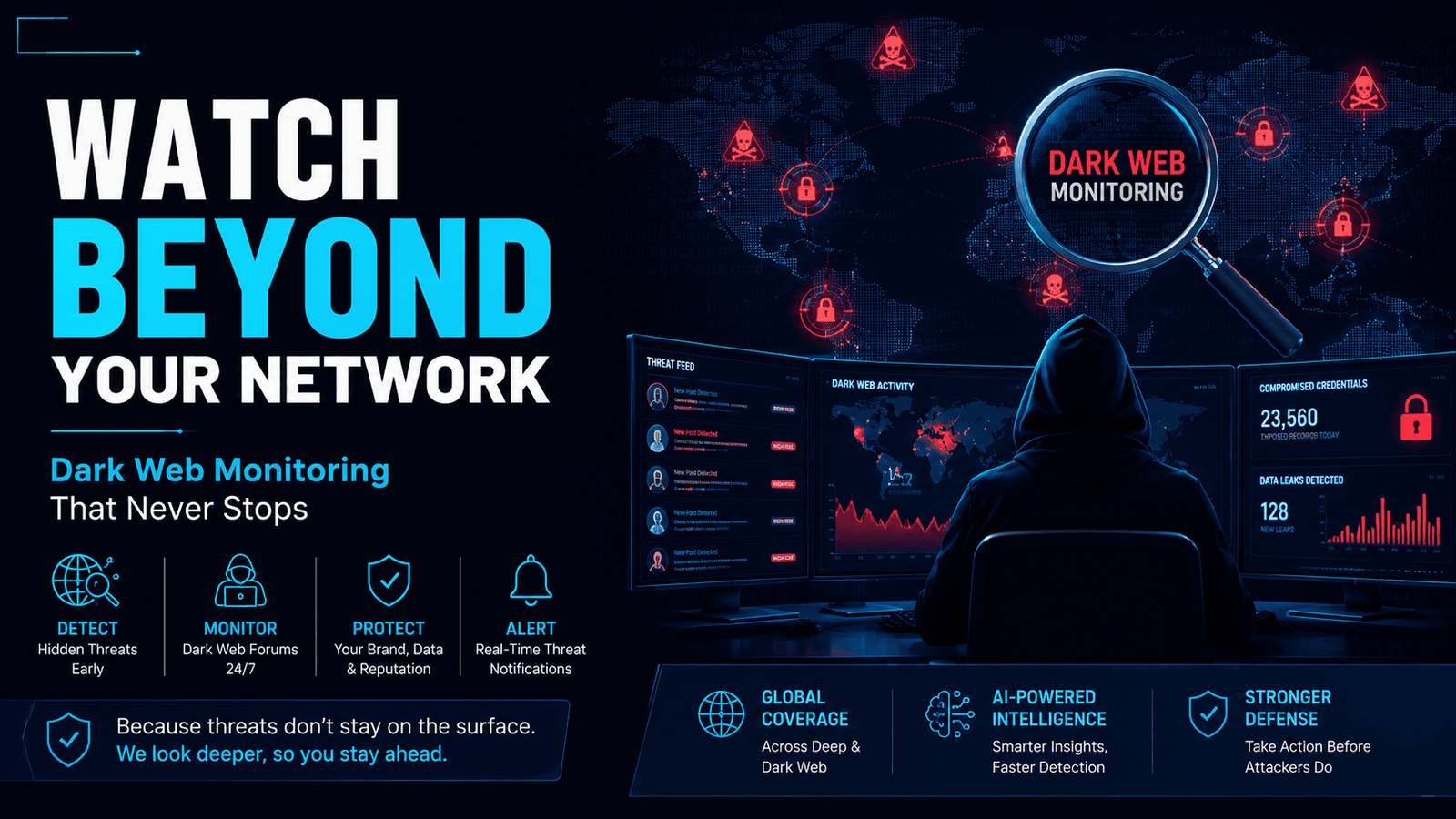
How Dark Web Monitoring Detects Threats Before They Strike
Dark web monitoring services work fundamentally differently from perimeter defences like firewalls or antivirus software. Rather than waiting for an attacker to breach the network, monitoring tools search for signs that a breach has already happened somewhere else in the supply chain and that the resulting data is now being traded.
A mature dark web monitoring service typically covers:
- Credential leak detection matching exposed email-password combinations against an organisation's known domains.
- Brand and executive impersonation tracking identifying phishing kits or fake domains being prepared to target the organisation or its leadership.
- Source code and intellectual property leak detection flagging proprietary code or documents surfacing on leak sites.
- Vendor and third-party exposure monitoring since a breach at a supplier or SaaS partner often exposes shared credentials.
The value of this approach is speed. Cognyte's Luminar Threat Landscape research found that stolen access credentials published on dark web marketplaces grew roughly 28% year-over-year, which means the window between a credential being stolen and it being actively exploited is shrinking. Continuous dark web monitoring compresses an organisation's detection timeline from months to days, giving security teams the chance to force password resets and revoke access before attackers can act on what they have purchased.
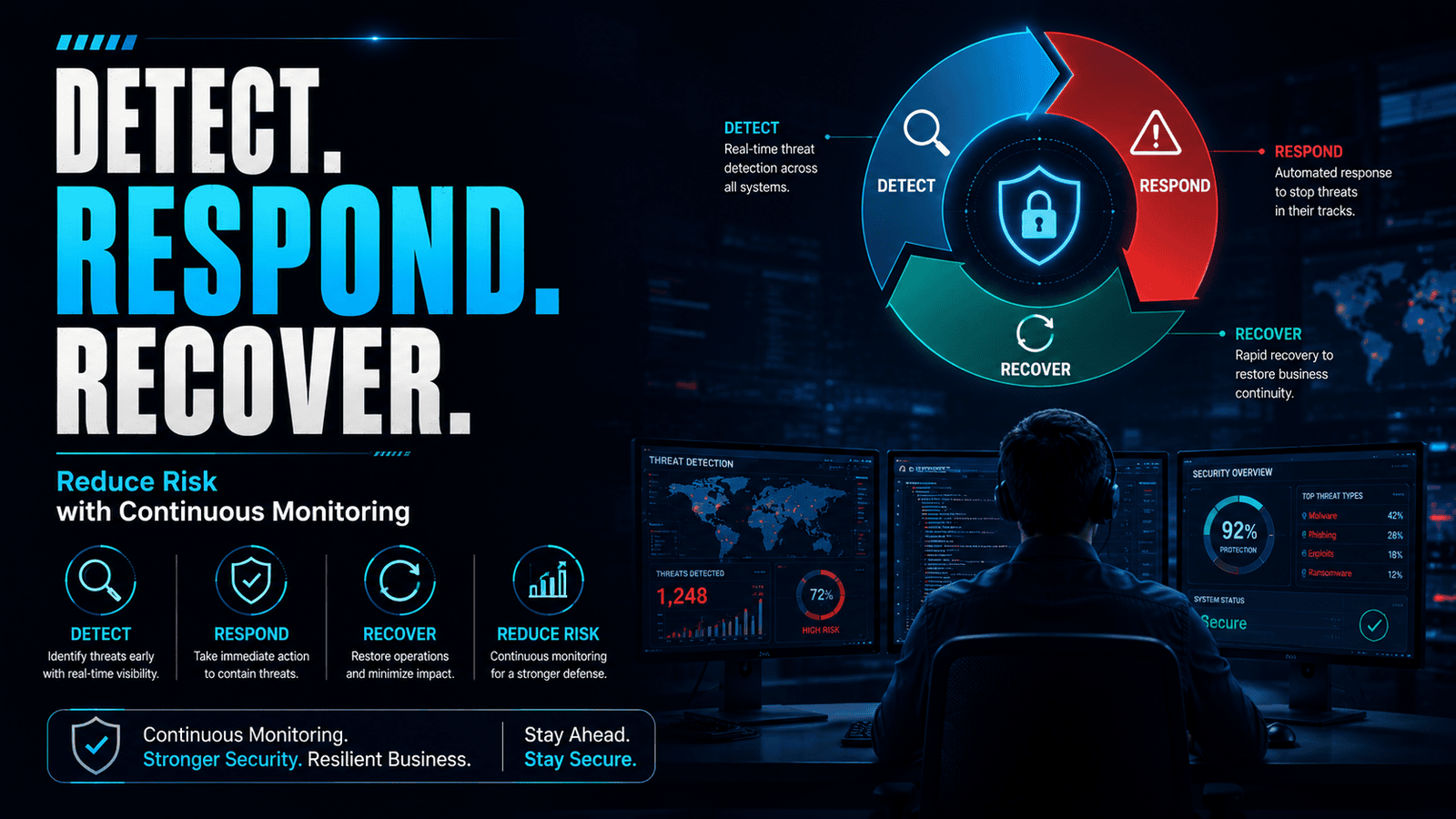
Integrating Cyber Risk Management, Data Security, and Dark Web Monitoring
We are often asked which of these three disciplines matters most. The honest answer is that the question itself is the problem. Treated separately, cyber risk management, data security solutions, and dark web monitoring services each address only part of the attack lifecycle:
- Cyber risk management identifies where an organisation is exposed and what it stands to lose.
- Data security solutions reduce the likelihood and impact of a successful breach.
- Dark web monitoring shortens the time to detection once prevention has failed.
An organisation that invests heavily in one pillar while neglecting the others ends up with predictable blind spots: excellent encryption but no visibility into leaked credentials, or a thorough risk register with no monitoring to confirm whether identified risks have actually materialised. We design engagements to run these three functions in parallel: a risk assessment informs which data assets need the strongest security controls, and dark web monitoring provides a continuous feedback loop that tells you whether those controls are holding.
Consider a realistic scenario: a mid-sized Indian financial services firm completes a risk assessment that flags customer payment data as its highest-value asset. Acting on that finding, the firm layers encryption and strict access controls around its payments database, a direct output of its data security programme. Three months later, dark web monitoring flags a batch of employee credentials for sale on a criminal forum, traced back to a third-party vendor breach rather than the firm's own systems. Because the three functions were already integrated, the firm can immediately confirm which systems those credentials could access, force a targeted password reset, and close the exposure within hours rather than discovering it during the next annual audit. That is what integration looks like in practice, not three separate reports sitting in three separate inboxes, but one continuous line of sight from risk to control to detection.
Regulatory Compliance in India: DPDP Act, CERT-In, and Sector Rules
Compliance has become a genuine driver of security investment in India, not just a paperwork exercise. Organisations now operate under several overlapping obligations:
- CERT-In's incident reporting rules require organisations to report qualifying cybersecurity incidents within six hours of detection, one of the shortest mandatory reporting windows globally.
- The DPDP Act 2023 establishes obligations around consent, data minimisation, and "reasonable security safeguards" for any entity processing personal data of Indian residents.
- Critical Information Infrastructure (CII) operators face additional notification requirements to the National Critical Information Infrastructure Protection Centre (NCIIPC).
- Listed companies must disclose material cyber incidents to the BSE or NSE within 24 hours, adding a market-disclosure dimension that did not exist a decade ago.
A six-hour reporting clock is nearly impossible to meet without dark web monitoring and internal detection tools already running, because you cannot report what you have not yet detected. This is one of the clearest practical arguments for treating data privacy and security compliance as an operational capability rather than an annual audit item.
We also see compliance obligations increasingly overlapping with sector-specific regulation RBI guidelines for banks and NBFCs, IRDAI requirements for insurers, and SEBI's cybersecurity and cyber resilience framework for market intermediaries. Rather than building a separate compliance layer for each regulator, we typically help organisations design one control framework that satisfies the strictest applicable requirement, then map every other regulatory obligation onto it. This avoids the common trap of maintaining three overlapping compliance programmes that quietly drift out of sync with one another over time.
Choosing the Right Cybersecurity Partner for Your Organisation
Given the scale of the threat landscape, the question for most Indian businesses is no longer whether to invest in cybersecurity, but how to choose a partner capable of delivering all three pillars coherently. We recommend evaluating potential partners against a short set of criteria:
- Breadth of coverage does the partner offer integrated cyber risk management, data security, and dark web monitoring, or only one in isolation?
- Regulatory fluency can they map controls directly to DPDP Act and CERT-In obligations relevant to your sector?
- Detection speed what is their average time from credential exposure to client notification?
- Track record with businesses of comparable scale a framework built for a multinational bank rarely transfers cleanly to a mid-sized manufacturer.
We built our own practice around exactly this integrated model because we have seen too many organisations discover after a breach that their security spend was scattered across tools that never spoke to one another.
Key Takeaways
- Indian organisations face 3,195 weekly cyberattacks on average, 62% above the global average, with CERT-In incident volumes more than doubling since 2021.
- Cyber risk management should start with business impact and asset mapping, not technology purchases.
- Data security solutions must cover data at rest, in transit, and in use encryption alone is not sufficient.
- Poorly secured APIs and unmonitored endpoints remain the leading cause of major Indian data breaches.
- More than 15 billion stolen credentials are circulating on the dark web, making dark web monitoring services essential for early breach detection.
- CERT-In's six-hour reporting window and the DPDP Act make continuous monitoring a compliance necessity, not a luxury.
- The strongest security postures integrate risk management, data protection, and dark web monitoring as one continuous system rather than three separate purchases.
Frequently Asked Questions
Q: What is cyber risk management, and why does it matter for Indian businesses?
A: Cyber risk management is the ongoing process of identifying, assessing, and prioritising digital threats based on business impact, then applying proportionate controls. It matters in India because CERT-In now logs nearly 2.94 million incidents a year, and the World Economic Forum ranks cybersecurity as the country's top national risk.
Q: How are data security solutions different from general IT security?
A: Data security solutions focus specifically on protecting data itself through encryption, access controls, and data loss prevention across its entire lifecycle, rather than only securing the network perimeter or individual devices.
Q: What exactly do dark web monitoring services do?
A: They continuously scan Tor networks, criminal forums, paste sites, and closed messaging channels for signs that an organisation's credentials, domains, or data have been leaked or put up for sale, enabling teams to act before stolen data is exploited.
Q: How often should a company run a cyber risk assessment?
A: Given how quickly threat landscapes shift, we recommend continuous or quarterly reassessment rather than an annual audit, particularly for organisations handling customer financial or personal data.
Q: What are the legal cybersecurity obligations for businesses operating in India?
A: Key obligations include CERT-In's six-hour incident reporting rule, the DPDP Act 2023's requirements around consent and reasonable security safeguards, NCIIPC notification for critical infrastructure operators, and 24-hour disclosure requirements for BSE/NSE-listed companies.
Q: Can small and mid-sized Indian businesses afford integrated cybersecurity coverage?
A: Yes many providers now offer tiered engagements that scale risk assessment, data security, and dark web monitoring to the size of the organisation, which is typically far less costly than the average breach cost of roughly $3.2 million in India.
Protect Your Business Before Attackers Strike, Discover enterprise-grade Cyber Risk Management, Data Security & Dark Web Monitoring with Delphi Infotech.